
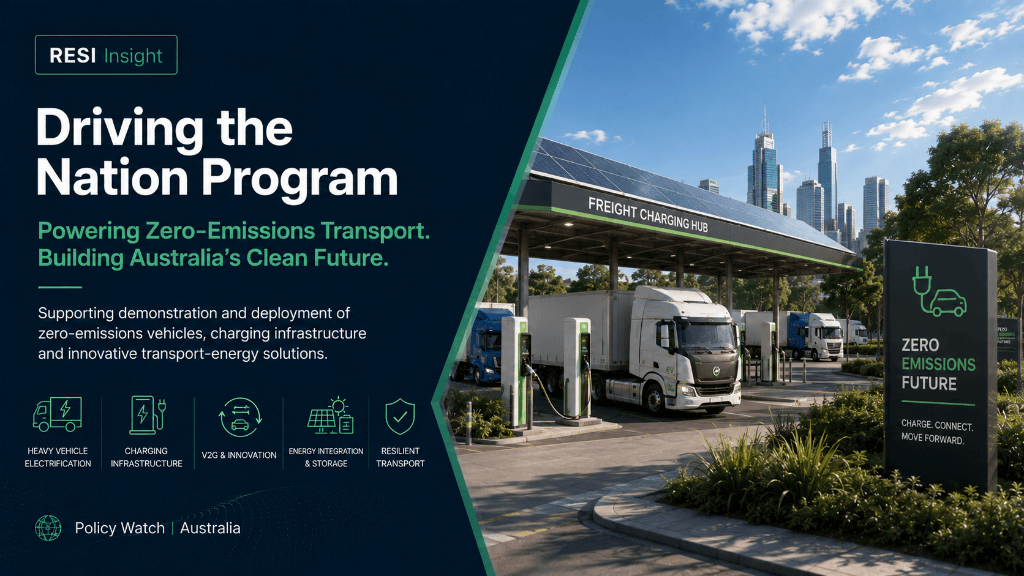
RESI Continues to Monitor Zero-Emissions Transport Policy: What Charging and Transport Infrastructure Opportunities Is the Driving the Nation Program Creating?
For businesses and organisations seeking government funding, GrantConnect and the Australian Government’s regional infrastructure funding pages are important official sources for identifying policy opportunities. The key issue is not simply knowing that a grant exists, but understanding which infrastructure priorities are attracting public investment and whether an organisation’s engineering, advisory and project-delivery capabilities are well positioned to participate.
RESI Continues to Monitor Zero-Emissions Transport Policy: What Charging and Transport Infrastructure Opportunities Is the Driving the Nation Program Creating?
If your work involves electric-vehicle charging infrastructure, logistics precincts, heavy vehicles, fleet electrification, energy management, vehicle-to-grid technology or commercial-site upgrades, the Driving the Nation Program is a policy opportunity worth monitoring.
Driving the Nation Program
Managed by ARENA, the Driving the Nation Program supports the development, demonstration and deployment of technologies and projects that accelerate the uptake of zero-emissions vehicles.
The programme remains open on an ongoing basis. The current focus areas are:
Trucks: demonstration and deployment of heavy battery-electric trucks, including new and emerging use cases and projects that demonstrate a pathway to scale.
Charging: deployment of charging solutions for heavy battery-electric vehicles, including freight charging hubs, high-capacity charging and freight-corridor infrastructure.
V2G and Innovation: vehicle-to-grid and vehicle-to-home applications, innovative charging solutions, and new technologies and business models involving light or heavy battery-electric vehicles.
The programme is intended not only to increase the number of electric vehicles, but also to address practical barriers to adoption, improve integration between vehicles and the electricity system, and establish infrastructure and business models that can be replicated at scale.
Why Should the Construction Sector Pay Attention?
Driving the Nation is not a conventional construction grant, but it may directly stimulate a range of physical infrastructure projects, including:
Heavy-vehicle charging stations.
Electrical upgrades associated with eligible fleet-electrification projects.
Shared charging hubs.
High-capacity and freight-corridor charging infrastructure.
Installation of charging equipment, transformers and distribution systems.
Energy-management systems for commercial and industrial sites.
Integration of solar, battery storage and charging infrastructure.
Vehicle-to-grid facilities.
Site upgrades supporting transport and logistics operations.
It is important to distinguish between the programme’s different focus areas. Under the Charging focus area, depot or back-to-base charging infrastructure serving a single fleet is not in scope. However, charging infrastructure and electrical upgrades may form part of an eligible Trucks project where they are required to support a qualifying heavy battery-electric truck deployment.
These projects commonly require site planning, electricity-capacity assessment, civil works, electrical engineering, equipment procurement, fire and safety design, and project management.
Accordingly, even where a construction or project-management business is not the lead technology applicant, it may participate through design, construction and supporting delivery services.
Which Organisations Should Consider the Programme?
The programme may be relevant to a broad range of organisations involved in transport, energy, property and technology, including:
Heavy-vehicle and logistics fleet operators.
Electric-vehicle charging-infrastructure developers.
Charge point operators.
Energy-management, battery-storage and smart-grid businesses.
Renewable-energy and electricity-network participants.
Vehicle-to-grid technology and platform providers.
Owners and operators of commercial property, logistics precincts and industrial sites.
Distribution centres, warehouses and other freight-related facilities.
Project teams testing new transport-energy business models.
Lead organisations capable of coordinating vehicle, energy, site and technology partners.
Participation in these sectors does not automatically make an organisation eligible as the lead applicant. Applicants must also satisfy ARENA’s general eligibility requirements and demonstrate that the proposed project aligns with one or more of the current Driving the Nation focus areas.
Unlike a standard electric-vehicle charger rebate, Driving the Nation places greater emphasis on demonstration value, innovation and replicability. A project must generally show not only that equipment can be installed, but also that it addresses a recognised market or technical barrier and can generate useful evidence for wider deployment.
How Should the Funding Be Understood?
Driving the Nation does not prescribe a single fixed grant amount for all projects.
Under the current Program Guidelines, the minimum grant amount sought by an applicant is expected to be A$500,000, and applicants are typically expected to at least match the funding sought from ARENA. For the current Trucks, Charging, and V2G and Innovation focus areas, ARENA expects grants of at least A$1 million.
Funding decisions are assessed on overall value for money, including the project’s contribution to programme objectives, the applicant’s capability and capacity, project design and risk, financial viability and co-funding commitment, and the need for ARENA support.
The programme has supported several funding initiatives over time. These include an earlier A$70 million allocation supporting innovation in electric-vehicle charging and a subsequent A$100 million commitment across focus areas supporting heavy battery-electric vehicles, charging solutions and related innovation.
It has also supported substantial demonstration projects. For example, Australia’s first shared electric-truck charging hub received A$12.3 million in ARENA support.
These figures reflect funding allocations and project commitments announced at different stages of the programme and should not be interpreted as the amount of funding currently available.
They do, however, demonstrate that projects with strong demonstration value, significant infrastructure requirements and broad industry impact may attract substantial support.
Where Does the Application Difficulty Lie?
Driving the Nation is open on an ongoing basis, but an ongoing programme is not necessarily an easy one to access.
Prospective applicants are expected to engage with ARENA before submitting an Expression of Interest and must ensure that the project aligns with one or more of the current focus areas.
A key consideration is whether ARENA funding is genuinely necessary for the project to proceed. Applicants need to demonstrate the additional value created by government support rather than simply seeking funding for an activity that would proceed commercially without ARENA assistance.
Project materials will generally need to explain:
The market or technical barrier being addressed.
The proposed technology and infrastructure solution.
The project’s demonstration value and potential for replication.
The participating organisations and partnership structure.
The financial model, co-funding commitment and sources of funding.
Project risks and the proposed management approach.
Measurable energy, transport and emissions outcomes.
How the project will generate knowledge-sharing and wider industry value.
The programme is therefore better suited to teams with a defined use case, credible partners, an identified project site and a preliminary commercial model than to applicants with only a general concept.
For infrastructure-intensive projects, this means that the technology solution alone is unlikely to be sufficient. Vehicle requirements, electricity supply, charging configuration, site constraints, project partners, capital costs and long-term operating arrangements may all need to form part of a credible project structure.
What Can RESI Do?
RESI continues to monitor policies affecting zero-emissions transport, charging infrastructure, energy systems and the construction sector. We also review the application logic, participation pathways and common barriers associated with relevant funding programmes.
Our aim is to help the industry assess at an early stage:
Whether a project aligns with the current Driving the Nation focus areas.
Whether the proposed applicant is positioned to meet the programme’s eligibility requirements.
Whether the site, vehicle, technology and energy partnership structure is sufficiently developed.
Whether the project has adequate demonstration and replication value.
Whether infrastructure requirements and delivery responsibilities have been clearly defined.
Whether a business should participate as an applicant, technology provider, site owner, adviser, contractor or delivery partner.
Whether the project has a credible co-funding and commercial structure.
Whether the opportunity justifies further engagement with ARENA and preparation of an Expression of Interest.
For complex infrastructure projects, clarifying the project position and participation model is often more valuable than moving directly into document preparation.
For construction, engineering and project-management businesses in particular, understanding whether the business should lead the funding application or participate as part of the downstream project-delivery team can be just as important as understanding the grant itself.
Contact RESI
If you are exploring heavy electric vehicles, logistics-fleet electrification, shared charging facilities, commercial-site energy upgrades, vehicle-to-grid technology or new transport infrastructure, the Driving the Nation Program warrants continued attention.
Because these projects often involve technology, energy infrastructure, sites, vehicles and multiple delivery partners, an initial feasibility and suitability assessment can help clarify project readiness. At the same time, early engagement with ARENA is encouraged before an Expression of Interest is submitted.
For businesses that may not be positioned to apply directly, the programme can also create opportunities to participate through engineering, electrical infrastructure, civil works, project management, site development and other supporting delivery services.
To discuss whether your project or service capability may be positioned to participate, please contact RESI.
References & Data Sources
Australian Renewable Energy Agency. (2025a). Driving the Nation Program Guidelines. 15 October 2025.
Australian Renewable Energy Agency. (2025b). Driving the Nation Program – Focus Areas: Trucks, Charging, V2G and Innovation. 15 October 2025.
Australian Renewable Energy Agency. (2025c). $12.3 million for Australian first shared truck charging hub. 11 September 2025.
Australian Renewable Energy Agency. (2024). Focus on heavy vehicle electrification set to drive innovation in transport sector. 9 November 2024.
Australian Renewable Energy Agency. (2023). Driving the Nation towards cheaper and cleaner transport. 19 April 2023.
Australian Renewable Energy Agency. (2026). Driving the Nation Program. Accessed 7 August 2026.
Australian Government. (2026). Driving the Nation (GO8121). GrantConnect. Accessed 7 August 2026.