
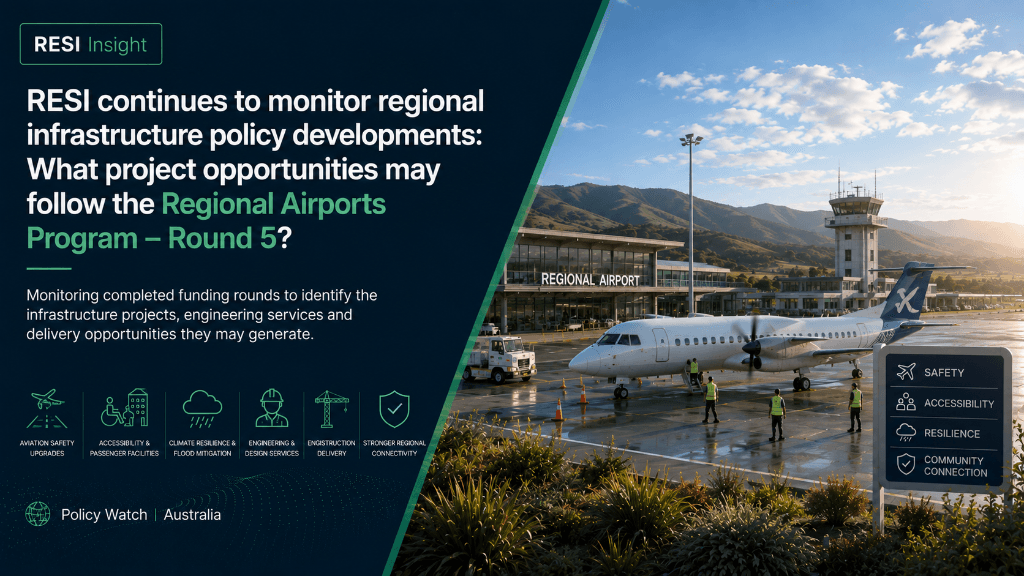
RESI continues to monitor regional infrastructure policy developments: What project opportunities may follow the Regional Airports Program – Round 5?
For businesses and organisations seeking government funding, GrantConnect and the Australian Government’s regional infrastructure funding pages are important official sources for identifying policy opportunities. The key issue is not simply knowing that a grant exists, but understanding which infrastructure priorities are attracting public investment and whether an organisation’s engineering, advisory and project-delivery capabilities are well positioned to participate.
RESI Continues to Monitor Regional Infrastructure Policy Developments: What Project Opportunities May Follow the Regional Airports Program – Round 5?
If your work involves regional infrastructure, engineering design, runway or aerodrome upgrades, project management, accessibility improvements or climate-resilience works, the Regional Airports Program – Round 5 remains worth monitoring because successful applications may generate future engineering, procurement, construction and project-delivery opportunities.
Regional Airports Program – Round 5
The programme supported owners and operators of regional airports and aerodromes across Australia to undertake projects that improve aviation safety, accessibility and climate resilience.
Round 5 is now closed to applications. Grants ranged from A$20,000 to A$5 million, with up to A$15 million available across the round. Applications closed at 5.00 pm AEST on 28 July 2026.
The programme was designed to support practical infrastructure projects that improve the safety, accessibility and operational continuity of regional aviation facilities.
Potential project areas included:
Runway, taxiway and apron upgrades.
Improvements to aerodrome lighting, navigational aids and safety equipment.
Basic airside ambulance and passenger shelters supporting patient health in transit.
Airside drainage and other infrastructure works aligned with the programme’s climate-resilience objectives.
Other essential works supporting regional aviation safety and community access.
Infrastructure supporting sustainable aviation fuel, lower-emission aircraft operations, electric charging or hydrogen storage and refuelling.
What Does This Mean for the Construction and Infrastructure Sectors?
Directly eligible applicants were generally required to be owners or operators of existing airports or aerodromes classified as Inner Regional or Outer Regional under the 2021 Australian Statistical Geography Standard, with passenger throughput below 300,000 passengers across all flight types in 2024.
Eligible state agencies or other entities could also act on behalf of an airport or aerodrome as the lead organisation in a joint application. Owners or operators of leased federal airports were not eligible.
Construction companies, engineering consultancies and project-management firms would not usually apply independently, but they may participate as project partners, advisers, contractors or downstream delivery providers.
It is important to note that these professional services are not necessarily grant-funded. The guidelines excluded project planning and design, research and feasibility costs, as well as other costs associated with pre-development approval. Costs associated with final engineering specifications and drawings required for the tender design and construction process may have been eligible, capped at 5% of eligible project costs.
For the construction sector, the value of the programme therefore lies not only in who could receive funding, but also in the pipeline of engineering, advisory and delivery work that successful projects may generate.
Regional airport projects commonly require multidisciplinary input, including:
Civil and structural engineering.
Runway and pavement works.
Electrical systems and aerodrome lighting.
Drainage and flood-mitigation design.
Environmental and climate-risk assessment.
Accessible design.
Cost planning and project management.
Construction, commissioning and compliance.
The programme is particularly relevant to businesses already working with government, local councils, regional infrastructure or transport projects.
Why Is the Funding Attractive?
With grants ranging from A$20,000 to A$5 million, Round 5 could support projects ranging from relatively small safety improvements to major infrastructure upgrades.
The grant could cover up to 50% of eligible project costs. Where both the applicant and a third party contributed to eligible project costs, the Commonwealth grant may have been reduced to one-third of eligible project costs.
Applicants remained responsible for the balance of eligible costs and all ineligible costs. They were also required to demonstrate their financial and delivery capacity and present a clear statement of need, delivery plan, cost basis and governance approach.
Applications therefore needed to demonstrate more than a construction concept. Applicants were required to show:
Why the project was necessary and time-critical.
Which aviation safety or accessibility issue it would address.
Whether the proposed scope and budget were reasonable.
Whether the project could be delivered within the required timeframe.
Whether the applicant could meet co-funding and ongoing operational responsibilities.
Why Does the Timing Still Matter?
Round 5 closed at 5.00 pm AEST on 28 July 2026. Under the Grant Opportunity Guidelines, successful projects are expected to commence around October 2026 and must be completed no later than 30 December 2028.
For engineering consultancies, project managers and contractors, the focus therefore shifts from supporting applications to monitoring funding announcements, procurement activity, tenders and project-delivery requirements.
Businesses already involved in application preparation may also assist with confirming project scope, preparing final engineering specifications, strengthening cost evidence and planning procurement, construction and compliant delivery.
Even where a business is not the direct applicant, it may support an eligible airport or aerodrome with feasibility assessment, project scoping and delivery planning, while recognising that some early-stage advisory costs may not be eligible for grant funding.
What Can RESI Do?
RESI continues to monitor policies affecting regional infrastructure, public works and community development. We also review the application logic, participation pathways and common barriers associated with relevant grant programmes.
Our aim is to help the industry assess:
Whether a proposed applicant is directly eligible.
Whether a construction or upgrade project aligns with the programme objectives.
Whether a business should participate as an applicant, partner, adviser or delivery provider.
Whether the project has a clear need, realistic budget and credible delivery pathway.
Whether participation in downstream procurement and delivery, or preparation for future funding rounds, is justified.
For many construction and advisory businesses, understanding the correct role within a grant-funded project is just as important as understanding the grant itself.
Contact RESI
If your business works across regional airports, aerodromes, runway upgrades, accessibility improvements, transport infrastructure or climate-resilience projects, it may be timely to monitor the funding outcomes, procurement activity and delivery opportunities arising from Round 5.
For businesses that did not participate in this round, the programme may also provide useful insight into future funding priorities and capability requirements.
To discuss how your project or service capability may align with relevant downstream opportunities, please contact RESI.
References & Data Sources
Australian Government. (2026a). Regional Airports Program – Round 5 (GO8107). GrantConnect. Accessed 31 July 2026.
Australian Government. (2026b). Regional Airports Program – Round 5. business.gov.au. Accessed 31 July 2026.
Department of Infrastructure, Transport, Regional Development, Communications, Sport and the Arts. (2026). Regional Airports Program – Round 5: Grant Opportunity Guidelines.