
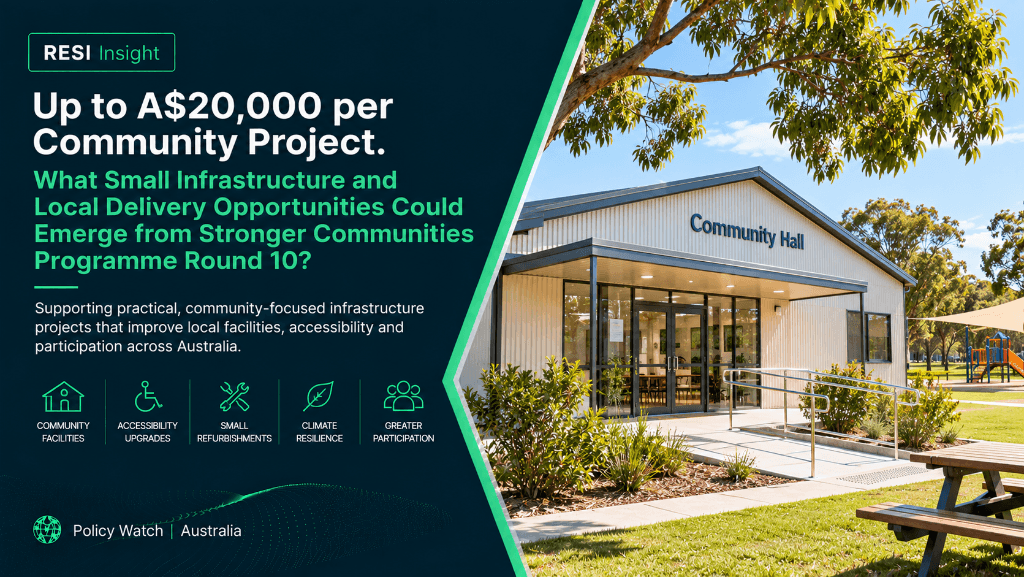
Up to A$20,000 per Community Project: What Small Infrastructure and Local Delivery Opportunities Could Emerge from Stronger Communities Programme Round 10?
The South Australian residential construction sector is entering 2026 with a combination of supportive planning conditions and persistent structural challenges. While government infrastructure investment and relatively efficient planning processes provide a favourable environment for development activity, labour shortages and industry capacity constraints continue to shape the operating landscape for builders and developers.
Up to A$20,000 per Community Project: What Small Infrastructure and Local Delivery Opportunities Could Emerge from Stronger Communities Programme Round 10?
Many community infrastructure projects in Australia do not require multi-million-dollar capital grants. For a community hall, sports club, local charity, Indigenous organisation or other not-for-profit, an accessibility upgrade, small refurbishment, equipment purchase, lighting improvement or climate-resilience measure costing only a few thousand or tens of thousands of dollars can materially improve the way a facility serves its community.
The currently open Stronger Communities Programme Round 10 is designed for this type of small capital project. Up to A$22.5 million is available under Round 10, with A$150,000 allocated to each of Australia’s 150 Federal electorates. Individual grants range from A$2,500 to A$20,000.
Round 10, however, differs from a conventional open grant in one important respect: an organisation cannot simply identify the programme and submit an application. A project must first pass through the local Federal MP’s community consultation, nomination and invitation process before a formal application can be lodged.
Stronger Communities Programme Round 10
The programme is intended to use small capital projects to generate practical social benefits for local communities. Its intended outcomes are to:
encourage and support participation in local projects;
improve local community participation; and
contribute to vibrant and viable communities.
It is therefore not ordinary commercial-development funding. A project must genuinely serve a community and establish a clear connection with one or more of the programme’s recognised social-benefit objectives.
Why Is the Nomination Process the First Major Gate?
Stronger Communities Programme Round 10 uses a Closed Non-Competitive process. Meeting the basic entity criteria does not, by itself, allow an organisation to apply.
A Federal MP must first identify potential applicants and projects through community consultation and formally invite the organisation to apply. For organisations, the first practical deadline is therefore not only the final application closing date, but the earlier MP nomination deadline.
MP nominations close at 5.00 pm AEDT on 30 November 2026. All invited applications must then be submitted by 5.00 pm AEDT on 19 January 2027.
For a community organisation assessing a project now, the first step is not necessarily to draft a long grant application. It is to clarify the project scope, community benefit, likely cost and nomination readiness, and to engage with the local MP’s office where appropriate.
How Much Funding Is Available per Project?
Individual grants range from A$2,500 to A$20,000. For most eligible applicants, grant funding may cover up to 100 per cent of eligible project costs.
Local governing bodies are treated differently. Grant funding may cover up to 50 per cent of eligible project costs, meaning the local government must provide at least 50 per cent in matched cash funding. In-kind contributions do not count towards that matched funding requirement.
The grant size is modest by infrastructure standards, but that is deliberate. The programme is designed to help communities address specific, achievable infrastructure needs rather than to finance large construction programmes.
Which Organisations Can Apply Directly?
A direct applicant must satisfy both the nomination requirement and the entity eligibility rules.
Direct applicants must also hold an ABN, be nominated and invited by their local Federal MP, and propose a project located within the nominating MP’s electorate.
Eligible entities principally include:
incorporated not-for-profit community organisations;
companies limited by guarantee;
non-distributing co-operatives;
Australian Indigenous corporations;
incorporated religious organisations;
eligible incorporated trustees;
local governing bodies; and
specified Commonwealth, state or territory emergency-service agencies or entities, such as fire services, rural fire services and state emergency services.
For-profit businesses, individuals, partnerships, universities, technical colleges, schools and hospitals are not eligible as direct applicants under Round 10.
This makes it important to distinguish direct applicant eligibility from commercial participation. A builder, engineer, supplier or consultant may not receive the grant directly but may still participate through procurement, contracting or project delivery.
What Types of Projects Deserve Attention?
The programme’s social-benefit objectives are broader than simple community-hall refurbishment. Eligible projects may relate to:
community participation and social cohesion;
Indigenous Australians;
veterans and defence communities;
newly arrived migrants;
specific student cohorts;
medical services and facilities;
children’s physical and mental wellbeing;
community health;
greenhouse-gas emissions mitigation;
climate adaptation and resilience;
biodiversity;
disability access; and
equality of access to public infrastructure.
Practical projects may therefore include community-hall upgrades, disability-access improvements, small sports-facility works, lighting or electrical upgrades, equipment purchases, energy-efficiency improvements, small climate-resilience works, facility refurbishment, safety improvements or accessibility amenities.
These activities are not automatically eligible on their own. The project must directly align with at least one programme objective and a corresponding eligible activity under the Round 10 Guidelines.
Why Should Construction and Professional Services Businesses Pay Attention?
Round 10 expressly allows a range of direct project-delivery costs as eligible expenditure, including:
suppliers and contracted labour;
planning, architectural, engineering and design fees;
consultant fees;
environmental or other regulatory approvals;
equipment and materials; and
equipment lease or hire.
In other words, the grant recipient may be a community organisation, but the organisations delivering the project are often local builders, trades, architects, engineers, planners, consultants and equipment suppliers.
For these businesses, the useful question is therefore not only, “Can we apply for this grant?” but also, “Which nominated community organisations may soon need scoping, cost estimates, design advice, pricing, equipment quotations and project-delivery support?”
Why Can a Small Grant Still Matter Commercially?
A$20,000 is small compared with major infrastructure funding, but the programme uses a distributed model: each of the 150 Federal electorates receives an allocation of A$150,000.
The result is not a small number of major projects, but the potential for many modest projects to emerge across different local markets. This may not represent a major pipeline for a national contractor, but for a local builder, trade, consultant or supplier, a cluster of modest community projects, with total project costs potentially reaching A$50,000, can still represent real commercial activity.
Why Do Project Timing and Expenditure Rules Matter?
The programme will not fund a project that has already started or where contracts are already in place when the application is submitted. Project expenditure incurred before submission is not eligible grant expenditure.
Projects must be completed by 31 March 2028. For construction, approval-dependent works or equipment procurement, organisations should therefore allow for sourcing delays, council approvals, contractor availability, weather and other delivery risks.
A small grant does not necessarily mean a simple project. An A$15,000 accessibility upgrade may still require design, owner approval, regulatory approval, supplier lead times and contractor scheduling.
What Does a More Mature Project Look Like?
Officially, eligible applications are assessed against a single 100-point criterion focused on alignment between the proposed project activities and the programme objectives and outcomes.
Round 10 is not strengthened simply by making an application longer. The key issue is whether the proposed activities are directly connected to the programme objectives and whether the project logic is clear.
A more mature project should be able to explain:
what the underlying community need is;
why the proposed project scope addresses that need;
why the proposed expenditure is necessary and reasonable;
which community users will benefit and how;
whether the project can be completed within the required timeframe; and
whether approvals, owner consent, construction delivery and other preconditions have been considered.
Why Is It Worth Monitoring Now?
Round 10 remains open. MP nominations close at 5.00 pm AEDT on 30 November 2026, and invited applications must be submitted by 5.00 pm AEDT on 19 January 2027.
For community organisations, the immediate priorities are nomination status, project fit and readiness. For builders, consultants and suppliers, the opportunity is to identify local organisations that may enter the nomination pipeline and to be ready to support them with scoping, pricing and delivery planning.
What Can RESI Do?
RESI continues to monitor Australian community infrastructure, regional development and government grant programmes.
Our aim is to help organisations assess at an earlier stage:
whether the organisation is an eligible applicant;
whether MP nomination is required;
whether the project is located within the relevant Federal electorate;
whether the project aligns with the community-benefit objectives;
whether the proposed works are eligible activities;
whether expenditure is likely to meet funding requirements;
whether a local government applicant requires matched cash funding;
whether the project should be led by a community organisation;
how a builder, consultant or supplier may participate as a downstream delivery provider; and
whether the project is sufficiently developed to justify nomination and formal application preparation.
For Round 10, a good project does not need to be large. The more important questions are whether the community need is genuine, whether the project scope is clear and whether a relatively modest capital investment can produce a specific and demonstrable social benefit.
Contact RESI
If your organisation is planning a community facility, accessibility upgrade, small infrastructure project, energy-efficiency improvement, climate-resilience measure or other local community project, Stronger Communities Programme Round 10 is worth assessing further.
MP nominations close at 5.00 pm AEDT on 30 November 2026, and invited applications must be submitted by 5.00 pm AEDT on 19 January 2027.
To discuss organisation eligibility, project fit, nomination strategy or downstream delivery opportunities, please contact RESI.
References & Data Sources
Australian Government, business.gov.au. (2026). Stronger Communities Programme Round 10.
Australian Government, business.gov.au. (2026). Stronger Communities Programme Round 10 – Frequently Asked Questions.
Australian Government, GrantConnect. (2026). Stronger Communities Programme Round 10, GO8525.
Department of Infrastructure, Transport, Regional Development, Communications, Sport and the Arts. (2026). Stronger Communities Programme Round 10 Grant Opportunity Guidelines.