
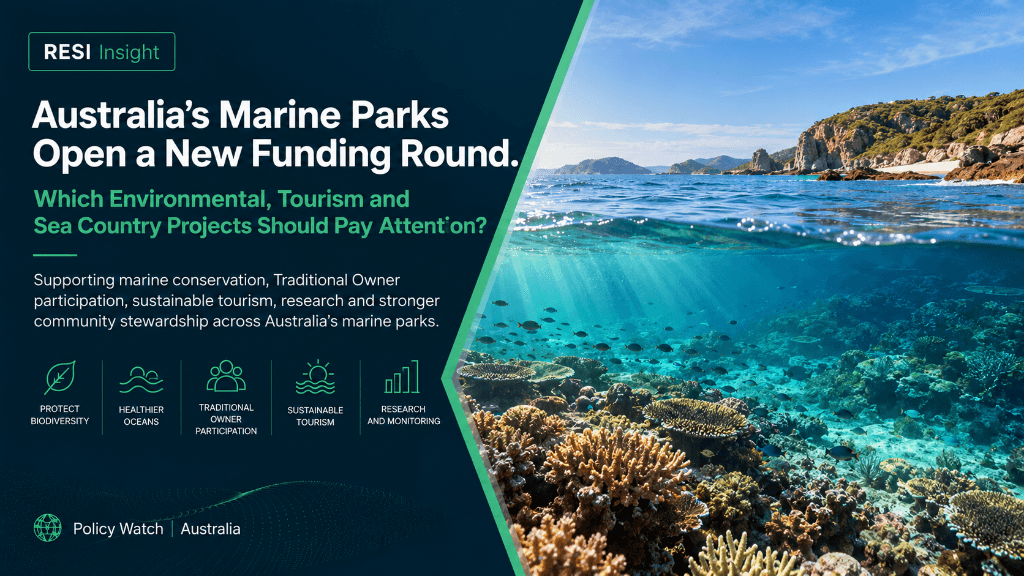
A New Funding Round for Australian Marine Parks: Which Environmental, Tourism and Sea Country Projects Should Pay Attention?
The South Australian residential construction sector is entering 2026 with a combination of supportive planning conditions and persistent structural challenges. While government infrastructure investment and relatively efficient planning processes provide a favourable environment for development activity, labour shortages and industry capacity constraints continue to shape the operating landscape for builders and developers.
A New Funding Round for Australian Marine Parks: Which Environmental, Tourism and Sea Country Projects Should Pay Attention?
Marine conservation is increasingly moving from a model centred on government management alone towards broader collaborative management.
Traditional Owners, tourism operators, commercial and recreational fishing sectors, scientists, community organisations and other marine park users are playing a growing role in Australia's marine conservation system.
The currently open Our Marine Parks Grants – Round 5 reflects this policy direction. The round uses an Open Competitive selection process and closes at 9.00 pm AEDT on 27 October 2026. A total of A$5.6 million is available under Round 5, with individual grants ranging from A$50,000 to A$500,000, GST exclusive. The programme is delivered on behalf of the Department of Climate Change, Energy, the Environment and Water and administered through the Community Grants Hub.
Our Marine Parks Grants – Round 5
A central objective of Round 5 is to increase the participation of Australian Marine Parks users in marine park management. The programme seeks to:
protect biodiversity;
improve ecosystem health;
strengthen culturally informed stewardship; and
increase marine park users' understanding of and participation in management.
Unlike some narrowly focused environmental restoration grants, Our Marine Parks Grants has a broad policy scope. It addresses environmental outcomes while also involving Traditional Owner participation, research, tourism, fishing, education, compliance and community engagement.
Traditional Owners Are a Core Part of the Programme
Round 5 supports Traditional Owners to:
document and maintain traditional knowledge associated with Sea Country;
protect cultural sites and cultural values; and
participate in Sea Country management within Australian Marine Parks and adjacent waters.
This means that First Nations participation is not treated simply as a stakeholder-engagement requirement. The programme recognises Traditional Owners as active participants in marine park management.
This is particularly relevant to organisations working across Sea Country, cultural mapping, traditional ecological knowledge and Indigenous-led marine management.
Which Project Areas Are Worth Monitoring?
Based on the current grant information, Round 5 objectives include:
building community capacity to participate in marine park management;
improving understanding of the social and environmental values of marine parks;
reducing threats and pressures;
improving marine park resilience;
helping relevant industries understand and participate in marine park management;
supporting tourism;
supporting participation by the commercial and recreational fishing sectors;
increasing public awareness;
supporting marine park user compliance; and
improving scientific knowledge through research and monitoring.
Potential projects may therefore span a wide range of activities, including:
marine biodiversity monitoring;
species and habitat research;
citizen science;
Sea Country management;
cultural knowledge documentation;
tourism education;
fishing-sector engagement;
marine-user education;
compliance support;
environmental threat monitoring;
resilience projects;
community stewardship; and
science communication.
Why Is the Eligible Participation Base Relatively Broad?
Round 5 allows a relatively diverse range of organisations to apply.
Eligible lead applicants must fall within one of the entity types specified in the Round 5 Guidelines:
Companies;
Cooperatives;
Corporate Commonwealth Entities;
Corporate State or Territory Entities;
Incorporated Associations;
Indigenous Corporations;
Local Governments;
Non-corporate Commonwealth Statutory Authorities;
Non-corporate State or Territory Entities;
Non-corporate State or Territory Statutory Authorities; and
Statutory Entities.
Trusts may also participate where the trustee itself is an eligible entity type.
Consortium arrangements may include partners that are not themselves eligible to act as the lead applicant, provided the lead organisation meets the programme's eligibility requirements and remains accountable for the grant.
Compared with grants limited to a particular facility owner or a narrowly defined applicant group, this creates a broader institutional base for participation.
Why Should Tourism and Fishing Businesses Pay Attention?
Marine park funding is not relevant only to environmental NGOs.
Round 5 explicitly recognises commercial fishing, recreational fishing and tourism as industries that need to understand and participate effectively in marine park management.
Projects may therefore address areas such as:
responsible visitor behaviour;
industry education;
marine park interpretation;
tourism operator participation;
fishing-sector awareness;
compliance; and
coexistence between conservation and commercial use.
From a regional-economy perspective, this is important because many coastal communities depend simultaneously on environmental quality, tourism, fishing and cultural values. Marine park policy can therefore also have important implications for regional economies.
Why Do Research and Monitoring Matter?
Round 5 also emphasises scientific knowledge generated through research and monitoring.
Projects are expected to align with Australian Marine Parks Science Priorities and/or priorities identified by First Nations groups.
This means research does not become relevant simply because it has scientific merit. It needs to demonstrate a clear connection to practical marine park management needs.
For universities, research organisations, environmental consultancies and monitoring-technology providers, this may create opportunities for new collaborations.
What Does This Mean for Environmental Service Businesses?
Even where a business is not the lead grant applicant, it may still participate in downstream delivery. Potential requirements may include:
marine ecology;
environmental monitoring;
GIS and spatial analysis;
underwater surveys;
cultural mapping;
marine data collection;
project management;
community engagement;
Indigenous engagement;
education and communication;
environmental technology; and
scientific reporting.
From RESI's perspective, the value of this funding opportunity is not limited to identifying who can apply. The larger question is which marine-management projects may be created and what capabilities those projects will require.
How Is This Different from the Great Barrier Reef Article?
The earlier Great Barrier Reef Community Stewardship Programme was more closely focused on Reef health, habitat restoration and community-based on-ground action.
Our Marine Parks Grants Round 5 has a broader scope. It addresses national Australian Marine Parks management, including Sea Country, marine park users, tourism, fishing, compliance, research, monitoring and management participation.
It is therefore better understood as a marine protected-area management funding programme rather than simply an environmental restoration grant.
Why Is It Worth Monitoring Now?
Round 5 opened on 13 August 2026 and closes at 9.00 pm AEDT on 27 October 2026.
The current indicative timetable includes:
27 October 2026: applications close and assessment begins;
approximately March 2027: successful applicants notified;
June 2027: projects expected to commence; and
1 May 2030: latest grant activity end date.
Projects may run for up to three years. That is particularly relevant for activities requiring long-term monitoring, community partnerships or sustained Sea Country engagement.
What Can RESI Do?
RESI continues to monitor environmental funding, regional economies, Traditional Owner participation and government programme delivery.
Our aim is to help organisations assess at an earlier stage:
whether a project aligns with marine park management priorities;
whether an organisation is an eligible entity;
whether a project genuinely supports Australian Marine Parks management;
whether activities in adjacent waters can clearly demonstrate a connection to marine park management;
whether Traditional Owner participation has been appropriately designed;
whether tourism, fishing, research and environmental outcomes form a coherent project logic;
whether an organisation should participate as an applicant, partner, consultant or delivery provider; and
whether the project is mature enough to proceed into formal application preparation.
For programmes of this kind, a strong project is not simply one that proposes an environmental activity. The more important question is how that activity will improve marine park management.
Contact RESI
If your organisation works across marine conservation, Sea Country, tourism, fishing, research, environmental monitoring or coastal and marine project delivery, Our Marine Parks Grants – Round 5 is worth assessing.
Round 5 uses an open competitive process and closes at 9.00 pm AEDT on 27 October 2026.
To assess how your project aligns with the programme objectives, eligibility requirements and participation model, please contact RESI.
References & Data Sources
Australian Government Community Grants Hub. (2026). Our Marine Parks Grants – Round 5.
Department of Climate Change, Energy, the Environment and Water. (2026). Our Marine Parks Grants – Round 5 Grant Opportunity documentation.
Parks Australia. (2026). Our Marine Parks Grants.
Parks Australia. (2026). Our Marine Parks Grants Round 5 – Application Support Seminar.