
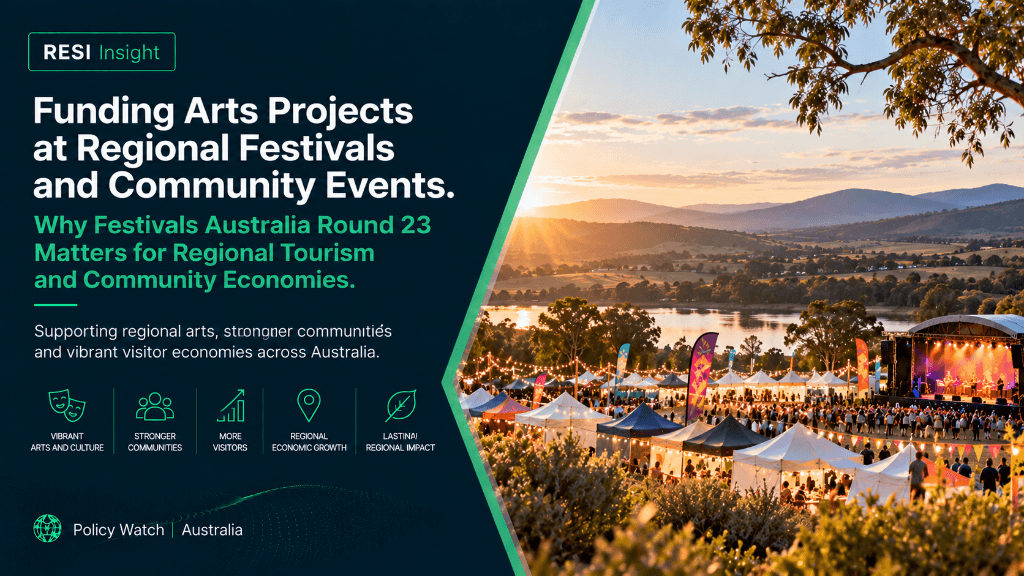
Funding Arts Projects at Regional Festivals and Community Events: Why Festivals Australia Round 23 Matters for Regional Tourism and Community Economies
The South Australian residential construction sector is entering 2026 with a combination of supportive planning conditions and persistent structural challenges. While government infrastructure investment and relatively efficient planning processes provide a favourable environment for development activity, labour shortages and industry capacity constraints continue to shape the operating landscape for builders and developers.
Funding Arts Projects at Regional Festivals and Community Events: Why Festivals Australia Round 23 Matters for Regional Tourism and Community Economies
Festivals and community events in regional and remote Australia are more than cultural activities.
They often connect local artists, community participation, tourism, regional identity and the visitor economy.
The currently open Festivals Australia – Round 23 is designed around this connection.
Through the Festivals Australia programme, the Australian Government provides approximately A$1.48 million in funding each financial year, subject to annual indexation, to support arts projects in regional and remote Australia. Approximately A$747,000 is available under Round 23. Round 23 is now open and closes on 13 October 2026; projects funded under this round must commence on or after 1 February 2027.
Festivals Australia Round 23
The core objective of Festivals Australia is to give people living in regional and remote communities greater opportunities to participate in and experience arts and cultural activities.
The programme supports arts projects delivered as part of a festival or significant one-off community celebration, including:
performances;
workshops;
installations;
parades;
exhibitions; and
other participatory arts experiences.
This means it does not simply fund the general operation of a festival.
Official programme guidance makes clear that Festivals Australia supports a specific arts project rather than a collection of unrelated activities.
This distinction is central to understanding programme eligibility.
Why Is This More Than an ‘Arts Grant’?
At first glance, the programme may appear to be focused solely on artists or cultural organisations.
However, from a regional-development perspective, festivals and community celebrations can create broader economic and social value. A highly engaging arts project may also contribute to:
local visitation;
accommodation demand;
hospitality spending;
transport;
local retail;
regional branding;
community participation;
local artist employment; and
destination identity.
The policy significance of Festivals Australia therefore extends beyond cultural participation.
It can also support regional communities by using compelling cultural experiences to strengthen local vitality and visitor appeal.
Which Organisations Should Pay Attention?
The Office for the Arts states that regional artists, arts workers and organisations may apply, provided the project supports community participation and audience engagement in regional or remote communities.
For a direct application, however, the applicant must meet the formal entity requirements in the Round 23 Guidelines. This generally requires an Australian incorporated organisation with an active ABN, with unincorporated groups able to apply through an eligible auspicing organisation.
From a practical delivery perspective, potentially relevant organisations may include:
arts organisations;
community organisations;
festival organisers;
regional cultural organisations;
local creative groups;
incorporated associations;
regional arts bodies;
local event organisations; and
organisations working with artists or cultural practitioners.
The key issue is not whether an organisation is large.
What matters more is whether the project genuinely takes place in an eligible regional or remote location and enables the local community to participate in, or gain access to, an arts experience.
Why Is Location Eligibility Particularly Important?
Festivals Australia is not available for projects in every Australian location.
Projects must take place in an eligible regional or remote location.
The Office for the Arts provides a dedicated Festivals Australia Eligibility Map. Applicants are required to enter the full project address to confirm the relevant Remoteness Area Classification Code and eligibility status.
A project may be strong in terms of artistic quality, community participation and delivery planning, but it will still be ineligible if the location does not meet the programme requirements.
This is therefore one of the first issues that should be confirmed during application preparation.
What Makes a Proposal More Compelling?
The Round 23 Guidelines assess eligible applications against four equally weighted criteria:
1. Quality – the quality of the proposed arts project, including the experience and capability of the organisation, artists and key personnel involved;
2. Access – the extent to which the project provides regional and remote communities with access to arts experiences, including likely attendance, participation, audience benefit and potential visitors to the region;
3. Support and Partnerships – the level of community support, engagement and partnership behind the project, including financial and project partners and cash or in-kind contributions; and
4. Value for Money – whether the project demonstrates a clear need for funding, a viable project plan and timeline, an appropriate budget and broader public benefit.
A strong proposal therefore needs to show not only that an arts activity is being planned, but that the project is well designed, accessible to regional audiences, supported by appropriate partners and capable of delivering value for the funding requested.
Community participation and audience engagement are particularly important. The project should provide meaningful opportunities for regional or remote communities to participate in or access the arts experience.
What Do Previous Projects Tell Us?
Previous recipients published by the Office for the Arts show that Festivals Australia supports a wide range of project types.
Recent examples have included:
live creation of large-scale murals at a regional Victorian festival;
creative workshops and digital animation as part of a screen festival in the Barossa Valley; and
an interdisciplinary cultural project at the Bribie Island Nature Festival involving First Nations designers, fashion performance, live music and immersive projections.
This highlights an important feature of the programme: it is not limited to a single art form.
What matters most is whether the project can:
generate community participation;
strengthen audience engagement; and
build a genuine connection with a regional or remote location.
What Does A$1.48 Million a Year Mean?
The Australian Government provides approximately A$1.48 million through Festivals Australia each financial year, subject to annual indexation, across two funding rounds.
Approximately A$747,000 is available under Round 23.
In programme-scale terms, this is not a major infrastructure fund.
Its value lies in the fact that funding is directed more closely towards specific community projects and can translate directly into regional cultural activity.
In the latest Round 22 funding outcome, more than A$730,000 was allocated across 25 regional and remote festival projects.
This suggests that individual grants may be smaller than large capital-funding programmes, but the programme can still achieve broad regional coverage and strong community participation.
Why Does This Funding Matter for Regional Tourism?
Festivals and cultural events have a defining characteristic: they take place at a specific time and in a specific location.
When a project attracts audiences from outside the local area, visitors must physically travel to the region.
Compared with online cultural content, this kind of physical visitation is more likely to generate demand for:
accommodation;
restaurants;
cafés;
local shops;
regional transport;
attractions; and
other tourism experiences.
From the perspective of the broader regional economy, Festivals Australia can therefore be understood as cultural-participation funding with the potential to generate visitor-economy spillovers.
However, this does not mean that the grant directly funds all tourism activity.
The core of the programme remains the arts project. Tourism and regional-economy benefits are potential downstream outcomes rather than substitutes for the programme’s cultural objectives.
Why Is It Worth Paying Attention Now?
Round 23 is currently open and closes on 13 October 2026.
For organisations preparing an application, the immediate questions include:
whether the project location meets regional or remote eligibility requirements;
whether the proposal is a clear, stand-alone arts project;
whether the project takes place within a festival or significant one-off community celebration;
whether community participation and audience access are genuine;
whether audience engagement is specific and measurable;
whether artist involvement is clearly defined;
whether the delivery timeline can commence on or after 1 February 2027; and
whether partnerships, budget and responsibilities are sufficiently developed.
For this type of grant, application quality is rarely improved simply by making the proposal longer.
What matters more is clearly explaining who will participate, where the project will take place, what the arts project actually is, how the community will engage, and why the project deserves support in that regional location.
What Can RESI Do?
RESI continues to monitor Australian regional development, community funding, tourism-related policy and government grant programmes.
Our aim is to help organisations assess at an earlier stage:
whether the project location meets eligibility requirements;
whether the proposed activity is an eligible arts project;
whether the festival or community celebration fits the programme context;
whether community participation is sufficiently clear;
whether the project narrative genuinely aligns with regional audience engagement;
whether the organisation should participate as a lead applicant, partner or delivery provider; and
whether the project is sufficiently developed to justify formal application preparation.
For regional organisations, whether a grant is worth pursuing should not be judged only by the funding amount.
More important is whether the project already has a sufficiently clear purpose, community value and delivery logic.
Contact RESI
If your organisation is planning a regional festival, community celebration, arts-participation project or other regional cultural initiative, Festivals Australia – Round 23 is worth assessing further.
Round 23 closes on 13 October 2026 and applies to projects commencing on or after 1 February 2027.
To discuss project eligibility, regional location, programme fit or application readiness, please contact RESI.
References & Data Sources
Australian Government, GrantConnect. (2026). Festivals Australia – Round 23, GO8607.
Australian Government, Department of Infrastructure, Transport, Regional Development, Communications, Sport and the Arts. (2026). Festivals Australia Program – Round 23 Guidelines.
Australian Government, Office for the Arts. (2026). Festivals Australia.
Australian Government, Office for the Arts. (2026). Applications now open for funding of regional and remote arts projects through the Festivals Australia program.
Australian Government, Office for the Arts. (2026). Regional arts.