
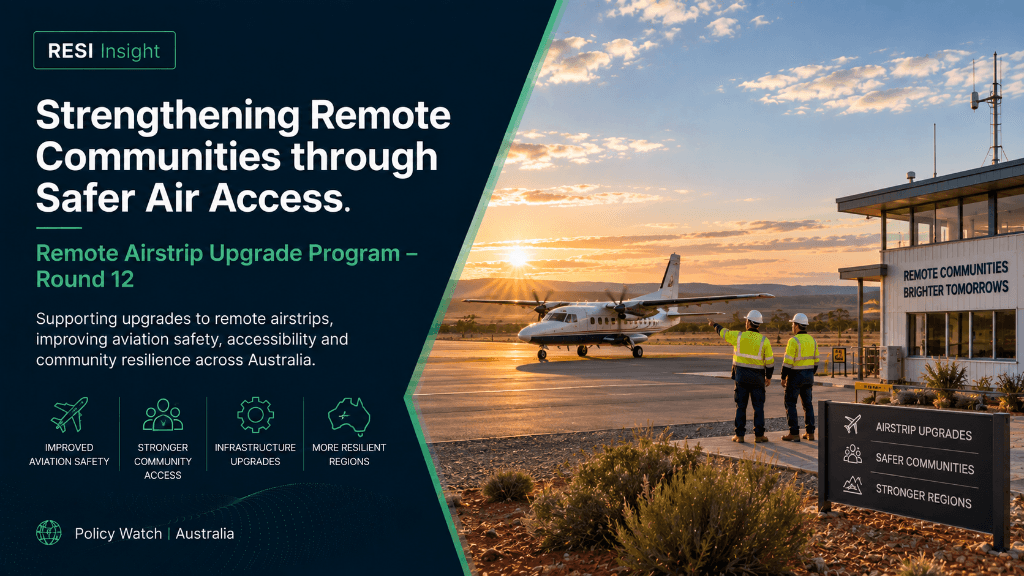
Up to A$4 Million per Project: What Remote Infrastructure Opportunities Could Emerge from the Remote Airstrip Upgrade Program – Round 12?
The South Australian residential construction sector is entering 2026 with a combination of supportive planning conditions and persistent structural challenges. While government infrastructure investment and relatively efficient planning processes provide a favourable environment for development activity, labour shortages and industry capacity constraints continue to shape the operating landscape for builders and developers.
Up to A$4 Million per Project: What Remote Infrastructure Opportunities Could Emerge from the Remote Airstrip Upgrade Program – Round 12?
Australia’s remote communities depend heavily on aviation infrastructure.
For many remote and very remote communities, an airstrip is more than a transport facility. It can provide essential access to aeromedical services, emergency response, critical supplies, education, employment and regional centres.
The currently open Remote Airstrip Upgrade Program – Round 12 provides up to A$25 million in total funding, with individual grants ranging from A$5,000 to A$4 million. Applications close at 5.00 pm AEST on 6 October 2026.
For businesses involved in civil works, aviation infrastructure, pavements, drainage, electrical systems, lighting, accessibility upgrades or project management, the round is worth monitoring.
Remote Airstrip Upgrade Program – Round 12
The Remote Airstrip Upgrade Program forms part of the Australian Government’s Regional Aviation Access Program and is designed to improve the safety and accessibility of aerodromes in remote and very remote areas of Australia.
These facilities can be particularly important where road access is limited, unreliable or disrupted by seasonal weather.
Safe and operational airstrips can support:
the Royal Flying Doctor Service and other aeromedical operations;
emergency services;
delivery of food, mail and other essential supplies;
passenger access;
education and employment opportunities; and
improved aviation access for people with disability.
Round 12 provides up to A$25 million in funding. Individual grants range from A$5,000 to A$4 million.
Commonwealth funding can generally cover up to 50 per cent of eligible project costs. Where both the applicant and a third party contribute to eligible project costs, the Commonwealth grant may be reduced to one-third of eligible project costs.
For applicants that meet the programme definition of an Indigenous Owned and/or Operated Aerodrome, funding may cover up to 100 per cent of eligible project costs. These applicants must still satisfy the eligibility requirements and compete through the assessment process.
What Infrastructure Can Be Supported?
The programme has a particularly direct connection with physical infrastructure delivery. Eligible activities can include:
sealing, resealing and re-sheeting aircraft pavements;
repair, restoration and reconstruction of airstrips, taxiways and aprons;
drainage works;
animal fencing;
markers and navigational aids;
runway and taxiway lighting;
power infrastructure for aerodrome lighting;
pilot-activated lighting control systems;
basic airside ambulance and passenger shelters; and
ramps, signage and other accessibility improvements.
Certain final engineering specifications, drawings and tender-design costs required for construction can also be eligible expenditure.
However, the funding does not extend to all development-related expenditure. Project planning, general design, research and feasibility costs associated with pre-development approval are ineligible, as are general terminal, hangar, commercial-development and aerodrome-building works, subject to specified exceptions for basic airside patient shelters and disability-access improvements.
The programme is therefore primarily focused on upgrading existing remote aerodrome infrastructure rather than funding new airport developments.
For the construction sector, this creates a relatively clear pathway from funding approval to design, procurement and physical delivery.
Why Should the Construction Sector Pay Attention?
It is important to distinguish between direct grant applicants and businesses that may ultimately deliver the funded works.
General construction businesses, engineering firms and project-management consultancies do not automatically qualify to apply.
Direct applicants generally need to own and/or operate an existing aerodrome or airport located in a Remote or Very Remote area under the latest Australian Statistical Geography Standard (ASGS) Remoteness Area classification and satisfy the programme’s entity requirements.
Eligible state agencies or other eligible entities may also apply on behalf of an aerodrome owner or operator as the lead organisation in a joint application. Owners or operators of leased federal airports are not eligible.
However, this does not reduce the commercial relevance of the programme for the construction sector. Once funding is approved, projects may require:
civil engineering;
pavement design and construction;
drainage design;
electrical engineering;
aviation-lighting installation;
fencing;
accessibility works;
construction contractors;
quantity surveying;
tender and procurement support;
project management; and
commissioning.
For construction and engineering businesses, the more useful question may therefore be not simply, “Can we apply for this grant?” but “Which funded aerodromes will subsequently move into procurement and construction?”
What Does the A$25 Million Round Signal?
Round 12 is part of a longer-running policy commitment.
The Australian Government has stated that more than A$140 million has already been committed across the previous 11 rounds, supporting 512 projects, with a further A$25 million now available through Round 12.
This highlights an ongoing policy focus on resilient infrastructure in remote Australia.
In communities with limited road access and highly dispersed populations, comparatively small aviation facilities can play a disproportionately important role in maintaining access to healthcare, emergency services, essential supplies and regional connections.
The value of these projects therefore extends beyond the physical airstrip itself. Improvements to pavements, drainage, lighting, fencing and accessibility can help maintain the reliability of essential aviation access in locations where alternative transport options may be limited.
What Makes a Project Competitive?
For direct applicants, demonstrated project need is particularly important.
The assessment framework gives significant weight to whether the proposed works address a clear infrastructure need, including improved all-weather access, aviation safety, aeromedical and emergency-service operations, and whether the project is time-critical.
The applicant’s capability and resources to deliver the project, together with the wider impact and benefit of the grant funding, are also assessed.
This means that the strongest projects are likely to demonstrate more than a need for general maintenance. They need to show why the infrastructure improvement matters, how it will improve access or safety, and whether the proposed project can be delivered effectively.
Which Businesses Should Pay Particular Attention?
The programme may be particularly relevant to:
civil construction contractors;
pavement and surfacing specialists;
drainage contractors;
electrical and aviation-lighting contractors;
fencing contractors;
accessibility contractors;
regional engineering consultancies;
airport and aerodrome specialists;
project-management consultancies;
quantity surveyors; and
aviation safety and navigation-equipment suppliers.
Businesses with demonstrated capacity to mobilise personnel, materials and equipment into remote areas may be particularly well positioned for downstream delivery opportunities.
For these businesses, the programme may be more relevant as a future procurement and construction pipeline than as a direct grant opportunity.
Why Is It Worth Monitoring Now?
Applications for Round 12 close at 5.00 pm AEST on 6 October 2026, and funded projects must be completed by 30 March 2029.
For direct applicants, the immediate focus is preparing the grant application and demonstrating project need, eligibility, funding capacity and delivery capability.
For contractors and engineering businesses, however, the more visible commercial opportunities may emerge after funding decisions are made.
Successful projects may still need to progress through:
scope confirmation;
final engineering design;
tender documentation;
procurement;
contract award;
construction; and
commissioning.
The closing of the grant round may therefore mark the beginning, rather than the end, of the construction opportunity.
For businesses seeking downstream work, monitoring which aerodromes receive funding and how those projects move into procurement may become increasingly important after the grant assessment process.
What Can RESI Do?
RESI continues to monitor regional development, transport infrastructure and government capital programmes, with a particular focus on how public funding can translate into practical engineering and construction opportunities.
Our aim is to help the industry assess at an earlier stage:
whether an organisation is directly eligible to apply;
whether a project aligns with the programme’s infrastructure objectives;
what downstream engineering and construction demand may emerge;
whether a business should participate as an applicant, designer, contractor, supplier or delivery provider;
which capabilities may align with future procurement requirements; and
whether it is worth preparing for future tender and construction opportunities.
For engineering and construction businesses, understanding where government funding is likely to create real projects can often be more valuable than focusing only on grants for which they can apply directly.
Contact RESI
If your business works across remote infrastructure, civil works, airport upgrades, pavements, drainage, electrical works, aviation lighting, project management or regional construction, the Remote Airstrip Upgrade Program – Round 12 is worth monitoring.
Even where a business is not a direct applicant, funded projects may create downstream demand for design, procurement, engineering and construction services.
To discuss where your project or service capability may fit within the delivery lifecycle, please contact RESI.
References & Data Sources
Australian Government. (2026). Remote Airstrip Upgrade Program – Round 12. business.gov.au. Accessed 4 September 2026.
Department of Infrastructure, Transport, Regional Development, Communications, Sport and the Arts. (2026a). Remote Airstrip Upgrade Program – Round 12: Grant Opportunity Guidelines. August 2026.
Department of Infrastructure, Transport, Regional Development, Communications, Sport and the Arts. (2026b). Remote Airstrip Upgrade Program applications open. 2 September 2026.