
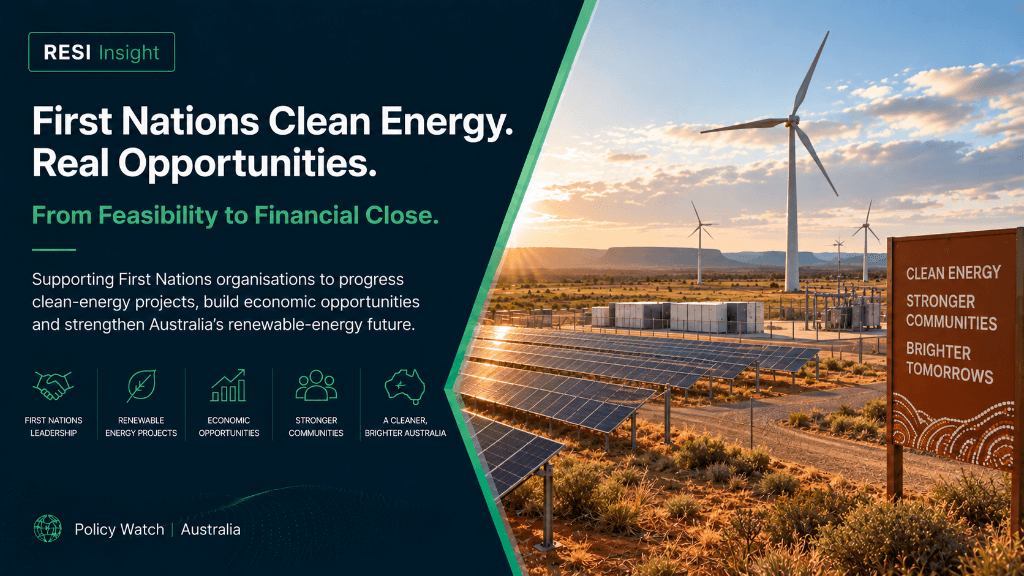
Up to A$10 Million and Up to 100% of Eligible Costs: How Could First Nations Clean Energy Projects Move from Feasibility Towards Financial Close?
The South Australian residential construction sector is entering 2026 with a combination of supportive planning conditions and persistent structural challenges. While government infrastructure investment and relatively efficient planning processes provide a favourable environment for development activity, labour shortages and industry capacity constraints continue to shape the operating landscape for builders and developers.
Up to A$10 Million and Up to 100% of Eligible Costs: How Could First Nations Clean Energy Projects Move from Feasibility Towards Financial Close?
Australia’s clean-energy policy is increasingly focused on a critical project-development challenge: how does a promising renewable-energy project move from feasibility into a financeable and deliverable investment?
The currently open First Nations Clean Energy Projects – Pilot Grants addresses that stage directly.
Up to A$10 million is available under the programme. Individual grants range from A$1 million to A$10 million, with funding of up to 100 per cent of eligible expenditure. Applications close at 5.00 pm AEST on 28 September 2026.
First Nations Clean Energy Projects – Pilot Grants
The programme forms part of the implementation of the Australian Government’s First Nations Clean Energy Strategy.
It is intended to support up to two First Nations organisations to progress clean-energy projects beyond feasibility towards financial close, while also building evidence about the conditions required to increase investment in First Nations clean-energy development.
The policy objective therefore extends beyond renewable-energy generation itself. It also seeks to support First Nations economic development, ownership, self-determination and long-term participation in the energy transition.
Why Does the Move from Feasibility to Financial Close Matter?
A clean-energy project generally requires substantial development work before construction finance can be secured. That work may include:
Front-End Engineering Design;
permits and regulatory approvals;
development approvals;
Environmental and Social Impact Assessments;
commercial arrangements;
contractual negotiations;
capital-raising activities;
project financing;
risk planning;
procurement planning;
execution planning;
workforce planning; and
engagement with Traditional Owners and communities.
The purpose of this funding is therefore not simply to subsidise a piece of equipment. It is designed to help sufficiently developed projects cross the complex development stage between feasibility and a position where they may be capable of attracting finance and progressing towards construction.
What Expenditure Can Be Supported?
Eligible expenditure can include:
engineering design;
technical specifications;
construction plans and schedules;
permits and approvals;
safety and operational certifications;
legal, audit and accounting costs;
capital-raising and financing activities;
commercial and contractual negotiations;
procurement planning;
execution planning;
risk management;
community and Traditional Owner engagement;
workforce planning; and
capability development, up to a maximum of 10 per cent of total eligible grant expenditure.
This distinction is important. The grant primarily supports project development leading towards financial close, but successful development work may ultimately determine whether a project becomes a real renewable-energy infrastructure investment.
Who Can Apply Directly?
Direct eligibility is deliberately targeted. Applicants must meet the programme definition of a First Nations organisation, hold an ABN and fall within one of the eligible entity categories.
These can include:
registered land councils;
Aboriginal and Torres Strait Islander Corporations;
companies limited by guarantee;
incorporated trustees;
eligible not-for-profit incorporated associations; and
eligible cooperatives.
For this programme, a First Nations organisation must be at least 51 per cent First Nations owned and controlled for the duration of the grant.
The broader clean-energy project must also have an expected capacity greater than 1 MW, be located in Australia, with the applicant able to demonstrate legal access to the project land and authority or support from the relevant Traditional Owners.
General renewable-energy developers, construction businesses and engineering consultancies therefore cannot simply apply independently as lead applicants.
Why Should the Energy and Construction Sectors Still Pay Attention?
A project progressing towards financial close usually requires a much broader delivery team. This may include:
renewable-energy developers;
engineering consultancies;
financial advisers;
planning consultants;
environmental advisers;
legal advisers;
grid specialists;
EPC contractors;
electrical contractors;
civil contractors;
project-management teams; and
technology and equipment suppliers.
For these businesses, the opportunity may not be the grant itself. It may be the opportunity to help an eligible First Nations organisation turn a project from feasibility into a financeable and construction-ready development.
What Does Up to 100% Funding Mean?
One of the most distinctive features of the programme is that grant funding may cover up to 100 per cent of eligible expenditure.
That does not mean the Australian Government will necessarily fund the entire future construction cost of a clean-energy project.
The programme is focused primarily on eligible development expenditure required to progress the project towards financial close.
Activities beyond financial close — including construction, commissioning, operations and maintenance — are not eligible under this grant. These later-stage costs will therefore require a broader financing and capital structure.
Which Projects May Be Worth Monitoring?
utility-scale solar;
renewable generation;
battery storage;
hybrid energy projects;
renewable-energy projects serving remote communities;
connection-related energy infrastructure;
clean-energy development associated with Indigenous land; and
projects with meaningful First Nations ownership and benefit-sharing structures.
What Can RESI Do?
RESI continues to monitor the connection between Australian clean-energy funding, First Nations participation, project development and infrastructure delivery.
Our aim is to help the industry assess at an earlier stage:
whether an organisation meets the direct applicant requirements;
whether a project has progressed beyond a purely conceptual stage;
whether the project is ready to proceed into FEED and approvals;
whether the site, technology, commercial model and project partners are sufficiently defined;
which engineering, planning and financing capabilities may be required;
whether a business should participate as an eligible applicant or eligible grant activity partner, or instead as a consultant, technology provider or future delivery contractor; and
whether the project has a credible pathway towards financial close.
Contact RESI
If your organisation is developing a First Nations-led solar, battery-storage, renewable-generation or other clean-energy project, the programme is worth assessing promptly.
Applications close at 5.00 pm AEST on 28 September 2026, and the grant activity must be completed by 30 June 2028.
Businesses that are not positioned to apply directly may still participate through engineering, project development, planning, commercial advisory, procurement or future construction services.
To discuss whether your project or capability may be worth progressing into the preparation stage, please contact RESI.
References & Data Sources
Australian Government, business.gov.au. (2026). First Nations Clean Energy Projects – Pilot Grants.
Department of Climate Change, Energy and Water. (2026). First Nations Clean Energy Projects – Pilot Grants: Grant Opportunity Guidelines.