
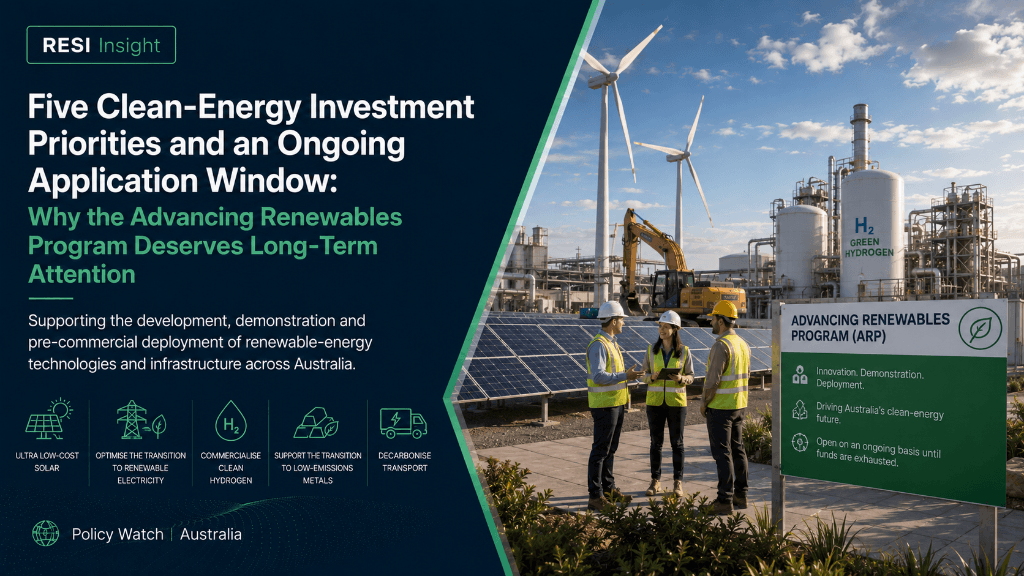
Five Clean-Energy Investment Focus Areas and an Ongoing Application Window: Why the Advancing Renewables Program Deserves Long-Term Attention from the Construction and Energy Sectors
The South Australian residential construction sector is entering 2026 with a combination of supportive planning conditions and persistent structural challenges. While government infrastructure investment and relatively efficient planning processes provide a favourable environment for development activity, labour shortages and industry capacity constraints continue to shape the operating landscape for builders and developers.
Five Clean-Energy Investment Focus Areas and an Ongoing Application Window: Why the Advancing Renewables Program Deserves Long-Term Attention from the Construction and Energy Sectors
Not every government funding opportunity depends on a short application window.
For businesses developing renewable-energy technologies, industrial-energy systems, hydrogen, low-emissions metals, solar or transport-decarbonisation projects, the Australian Renewable Energy Agency’s Advancing Renewables Program (ARP) provides a longer-term funding pathway.
The programme is currently open on an ongoing basis and will continue until available funding is exhausted, or until ARENA decides to close, extend or amend it. Applications are assessed periodically based on the project pipeline.
For large energy and infrastructure projects with longer development cycles, this flexibility can be particularly important.
Advancing Renewables Program
ARP supports the development, demonstration and pre-commercial deployment of renewable-energy technologies.
ARENA currently identifies five investment focus areas:
Ultra low-cost solar.
Optimise the transition to renewable electricity.
Commercialise clean hydrogen.
Support the transition to low-emissions metals.
Decarbonise transport.
This does not mean that every low-carbon project automatically qualifies.
Eligible projects must involve a Renewable Energy Technology, have the potential to contribute to the Program Outcomes and primarily undertake project activities in Australia. Pure early-stage research at Technology Readiness Levels 1–3 is not eligible, although research components may form part of a broader development, demonstration, deployment or commercialisation project.
For transport-decarbonisation projects, the appropriate ARENA funding pathway should also be considered against targeted programmes such as Driving the Nation.
Why Should the Construction Sector Pay Attention?
ARP is a technology and energy funding programme rather than a conventional construction grant.
However, when renewable-energy technologies move from the laboratory into demonstration, commercialisation and deployment, they often create real infrastructure requirements.
Potential project activity may include:
Solar-technology demonstration facilities.
Innovative renewable-electricity demonstration and integration projects.
Advanced storage, grid-support and renewable-integration systems.
Clean-hydrogen production facilities.
Electrolysers and related energy systems.
Low-emissions metals pilot and demonstration plants.
New industrial production equipment.
Electrical and energy infrastructure.
Transport-energy and charging infrastructure associated with eligible technology projects.
Pilot plants or demonstration plants required for technology commercialisation.
For the construction sector, the key point is the stage at which an energy technology moves from research into a phase that requires a real site, physical infrastructure and project delivery.
That transition can create demand for engineering design, electrical works, civil and structural works, equipment installation, building modifications, commissioning and project-management services.
How Should the Funding Be Understood?
Under the current Program Guidelines, ARENA funding awarded through ARP is expected to range from A$100,000 to A$50 million.
Applicants are typically expected to at least match the funding sought from ARENA. Funding requests above A$50 million may be considered but require approval from ARENA’s responsible Minister.
This means ARP can support projects at very different stages and scales, but larger funding requests are likely to require a correspondingly strong technical, commercial and delivery case.
An ongoing application window does not reduce the need to demonstrate project merit, co-funding capacity and genuine additionality from ARENA support.
What Does the A$25.3 Million SunDrive Project Demonstrate?
Individual projects help illustrate how ARP funding can support the transition from technology development towards industrial-scale deployment.
In 2025, ARENA announced up to A$25.3 million in funding through the Advancing Renewables Program for SunDrive to advance its copper-metallised solar-cell technology from research and development towards commercial-scale production tooling.
The project involves new production equipment, facility upgrades, technology commercialisation and commercial-scale equipment with an annual production capacity of approximately 300 MW.
The example demonstrates that ARP is not limited to early-stage research. Where a technology has sufficient maturity and industry value, funding may support the transition towards real industrialisation and commercial deployment.
For the construction and engineering sectors, this is particularly relevant because commercialisation may require more than the technology itself. It can also require upgraded facilities, production equipment, electrical infrastructure, installation, commissioning and supporting project delivery.
Low-Emissions Metals Could Also Create New Industrial Projects
Another area of particular relevance to the construction sector is low-emissions metals.
Within ARENA’s current project portfolio, Banksia Minerals is developing a low-emissions copper-production pilot plant through ARP to test chloride leaching and electrochemical production technology.
The project includes engineering design, construction, commissioning and operation of pilot infrastructure, illustrating how technology-development funding can move into a physical industrial project.
Calix’s ZESTY project is also progressing a hydrogen direct reduced iron / hot briquetted iron demonstration plant to explore lower-emissions pathways for iron and steel production.
The project includes development of a demonstration facility and engineering work supporting future commercial-scale deployment.
These examples reflect a broader trend: the boundary between clean-energy funding and future industrial infrastructure is becoming increasingly blurred.
For engineering and construction businesses, important future projects may not initially be described as construction projects. They may instead be framed as renewable-energy projects, industrial-innovation projects, hydrogen projects, green-metals projects or technology-commercialisation projects — but they may still require substantial physical infrastructure to be delivered.
Why Does the Ongoing Application Window Matter?
One of the main differences between ARP and short-cycle competitive grants is that the programme currently remains open on an ongoing basis.
Project teams therefore do not need to rush simply to meet a deadline only a few weeks away.
However, ongoing availability does not mean that access is straightforward.
ARENA expects prospective applicants to engage with the agency before submitting an Expression of Interest. Applications typically progress through an EOI stage followed by a Full Application stage.
For larger projects, the ongoing structure provides more time to refine:
The technical pathway.
The demonstration strategy.
The commercial model.
The project-partnership structure.
The project site.
The engineering scope.
The capital budget.
The revenue and market logic.
Project risks.
The longer-term commercialisation pathway.
ARP is therefore more suitable for teams with an established technical foundation that are considering how to move towards demonstration or larger-scale deployment than for projects that remain at a purely conceptual stage.
For businesses considering a major clean-energy or industrial project, the useful question is not simply whether ARP is open.
It is whether the technology, site, project structure, co-funding and delivery pathway are mature enough to justify engagement with ARENA.
Which Businesses Should Pay Particular Attention?
From RESI’s industry perspective, the following organisations may have particular reason to continue assessing ARP:
Renewable-energy technology developers.
Solar and battery-storage businesses developing eligible technologies or integration solutions.
Hydrogen technology companies and project developers.
Low-emissions steel, copper, aluminium and other metals-technology businesses.
Industrial-technology and advanced-manufacturing businesses.
Energy-infrastructure developers.
Electrical and grid-technology companies.
Technology-commercialisation teams.
Industrial engineering and EPC businesses.
Contractors capable of participating in pilot plants, demonstration plants and energy-infrastructure construction.
Construction capability alone does not make a business eligible for ARP funding.
However, once an eligible technology project moves into demonstration, commercialisation or deployment, it may create substantial engineering and construction demand.
For engineering firms, contractors and project-delivery businesses, the opportunity may therefore sit downstream of the grant itself.
What Can RESI Do?
RESI continues to monitor Australian renewable-energy, green-industry, construction-supply-chain and net-zero policies, with a focus on how funding opportunities can move from policy settings into real projects.
Our aim is to help the industry understand at an earlier stage:
Whether a project aligns with ARENA’s current investment focus areas.
Whether the technology has reached an appropriate level of maturity.
Whether there is a defined site and use case.
What engineering and infrastructure may be required.
Whether the project has a credible co-funding and commercial pathway.
Whether a business should participate as an applicant, technology partner, engineering provider or delivery contractor.
Whether ARP is the most appropriate ARENA funding pathway for the project.
Whether further engagement with ARENA is justified.
For long-term programmes of this kind, establishing a clear project position early can be more valuable than waiting until a specific funding announcement appears before starting to prepare.
Contact RESI
If your business is developing solar, battery-storage, hydrogen, low-emissions metals, industrial-energy technologies or transport-decarbonisation projects, the Advancing Renewables Program is worth monitoring over the longer term.
The programme remains open on an ongoing basis and continues to support projects aligned with ARENA’s five investment focus areas.
For businesses that are not positioned to apply directly, eligible projects may still create opportunities through engineering design, industrial construction, equipment supply, electrical infrastructure, commissioning and project delivery.
To discuss how your technology, project or engineering capability may align with relevant opportunities, please contact RESI.
References & Data Sources
Australian Renewable Energy Agency. (2026a). Advancing Renewables Program. Accessed 28 August 2026.
Australian Renewable Energy Agency. (2024). Advancing Renewables Program: Program Guidelines. November 2024.
Australian Renewable Energy Agency. (2025). ARENA commits $25.3 million to continue SunDrive’s copper solar cell breakthrough. 11 November 2025.
Australian Renewable Energy Agency. (2026b). SunDrive Technology Development.
Australian Renewable Energy Agency. (2026c). Redefining Copper Production Pilot Project.
Australian Renewable Energy Agency. (2026d). Calix – ZESTY Green Iron Demonstration Plant.
Australian Government. (2025). Advancing Renewables Program (GO8120). GrantConnect. Accessed 28 August 2026.