
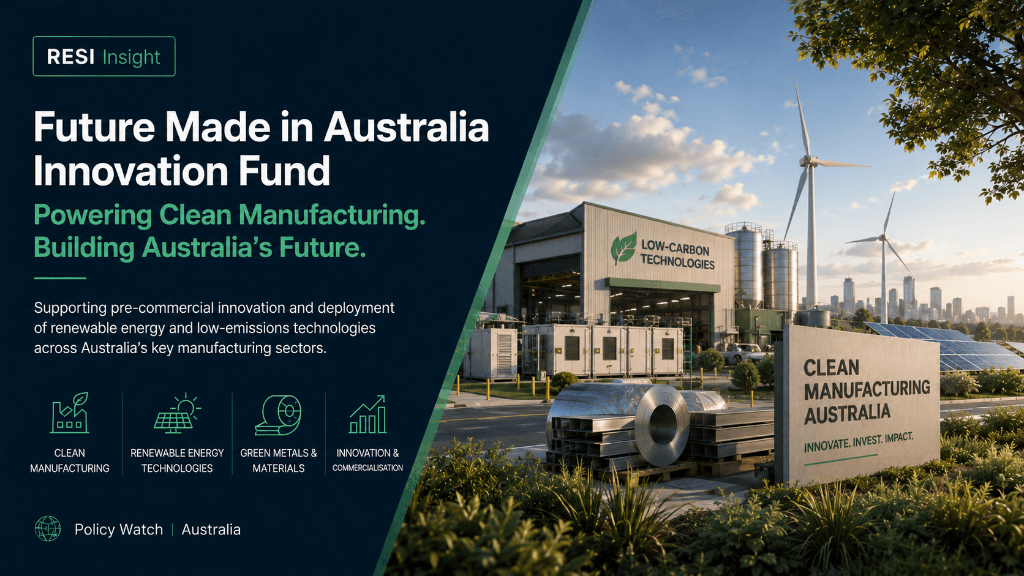
RESI Continues to Monitor Australian Clean Manufacturing Policy: Why the Future Made in Australia Innovation Fund Deserves Early Attention from Green Building Materials and Clean-Technology Businesses
For businesses and organisations seeking government funding support, GrantConnect remains an essential official resource to monitor. Policy windows often open quickly and close just as quickly. What matters is not simply knowing that a grant exists, but whether a business can identify at an early stage which policy opportunities are relevant to its sector and which projects are worth evaluating in greater detail.
RESI Continues to Monitor Australian Clean Manufacturing Policy: Why the Future Made in Australia Innovation Fund Deserves Early Attention from Green Building Materials and Clean-Technology Businesses
If your work involves green building materials, low-carbon products, renewable energy equipment, green metals, clean manufacturing or industrial technology commercialisation, the Future Made in Australia Innovation Fund is one of the most significant long-term policy opportunities currently available.
Future Made in Australia Innovation Fund
Managed by ARENA, the fund is intended to provide up to A$1.5 billion to support pre-commercial innovation, demonstration and deployment of renewable energy and low-emissions technologies. The programme remains open until funding is exhausted or ARENA formally closes it.
Current priority areas include:
Green Metals: support for low-carbon technologies in emissions-intensive industries such as iron, steel, alumina and aluminium, with up to A$750 million allocated.
Renewable Energy Technology Manufacturing: support for the Australian manufacture and commercialisation of renewable energy technologies, equipment and critical components, with an initial allocation of up to A$200 million.
Low Carbon Liquid Fuels: support for the innovation, demonstration and deployment of low-carbon liquid fuel technologies, with up to A$250 million allocated.
For the construction sector and its supply chains, the significance of this fund extends well beyond the energy industry. Building materials, metals processing, equipment manufacturing, energy-storage components, low-carbon production methods and clean-technology supply chains may all be affected by this policy direction.
Where a business is developing low-carbon construction materials, green-metal products, clean-energy equipment or new manufacturing processes, the fund may provide an important pathway from research and development to demonstration, validation and larger-scale deployment.
Why is early attention worthwhile?
First, the fund is large and remains open on an ongoing basis. Unlike smaller grant programmes with short application windows, it gives organisations more time to develop their technical proposal, commercial model, partnership structure and supporting evidence.
Second, it does not support routine equipment purchases or ordinary business expansion. Projects must demonstrate technological innovation, credible emissions-reduction value and commercialisation potential. Applicants need to explain why the project is innovative, what industry problem it addresses and how it can generate measurable environmental and economic benefits.
Under the Renewable Energy Technology Manufacturing priority, current public guidance indicates that grants start at A$250,000, while the maximum amount depends on project requirements and available funding. This makes the opportunity more suitable for projects with a defined technical pathway and commercialisation plan than for businesses that are still at the concept stage.
From an industry perspective, the policy signal is clear: Australia is directing more public investment towards clean manufacturing, green materials and sovereign industrial capability. Future competitiveness will depend not only on whether a business can deliver a product, but also on whether it can demonstrate low-emissions performance, scalability and value to Australian manufacturing.
Which businesses should assess the opportunity?
Businesses developing green steel, low-carbon aluminium or other lower-emissions construction materials.
Manufacturers of solar, energy-storage, energy-management or other renewable energy equipment and components.
Teams developing low-carbon fuels or related production technologies.
Clean-technology businesses that have completed early-stage research and are preparing for demonstration, validation or commercial deployment.
Project teams capable of working with research institutions, manufacturers, project owners or major industrial users.
This is not a straightforward grant in which an applicant submits a short form and waits for a decision. Businesses will generally need to engage with ARENA first and prepare a detailed project plan, financial proposal, risk analysis, technical pathway, commercialisation strategy and expected emissions outcomes.
The real challenge is therefore not finding the fund, but determining whether the project has reached the level of maturity required to enter ARENA’s assessment process.
What can RESI do?
RESI continues to monitor policies affecting clean manufacturing, green materials, construction supply chains and the net-zero transition. We also review the application logic, core processes and common barriers associated with relevant funding programmes.
Our aim is to help the industry assess at an early stage:
Whether a project falls within one of the fund’s current technology priorities.
Whether the technology has sufficient innovation and commercialisation potential.
Whether the organisation is ready to move into demonstration or deployment.
Whether the opportunity justifies further investment of time and resources.
For many businesses, completing an initial suitability assessment before contacting ARENA or commencing a formal application is more valuable than preparing materials prematurely.
Contact RESI
If you are exploring green building materials, low-carbon products, green metals, renewable energy equipment, clean manufacturing or technology commercialisation, the Future Made in Australia Innovation Fund warrants early consideration.
Given the technical requirements, financial structure and supporting documentation involved, an initial feasibility and suitability assessment is advisable before committing substantial resources. To discuss whether your technology or project may be ready to proceed, please contact RESI.
References & Data Sources
Australian Renewable Energy Agency. (2026). Future Made in Australia Innovation Fund.
Australian Renewable Energy Agency. (2026). FMA Innovation Fund Priority: Green Metals.
Australian Renewable Energy Agency. (2026). FMA Innovation Fund Priority: Renewable Energy Technology Manufacturing.
Australian Renewable Energy Agency. (2026). FMA Innovation Fund Priority: Low Carbon Liquid Fuels.
Australian Government GrantConnect. (2026). Current Grant Opportunity List and related official guidance pages.