
RESI Continues to Monitor Industrial Decarbonisation Policy Developments: Why the Powering the Regions Industrial Transformation Stream Merits Early Attention
For businesses and organisations seeking government funding support, GrantConnect remains an essential official resource to monitor. Policy windows often open quickly and close just as quickly. What matters is not simply knowing that a grant exists, but whether a business can identify at an early stage which policy opportunities are relevant to its sector and which projects are worth evaluating in greater detail.
RESI Continues to Monitor Industrial Decarbonisation Policy Developments: Why the Powering the Regions Industrial Transformation Stream Merits Early Attention
If your business operates in building materials, industrial manufacturing, low-carbon processing, energy efficiency improvement, or the wider construction supply chain, the Powering the Regions Industrial Transformation Stream is a programme worth examining closely.
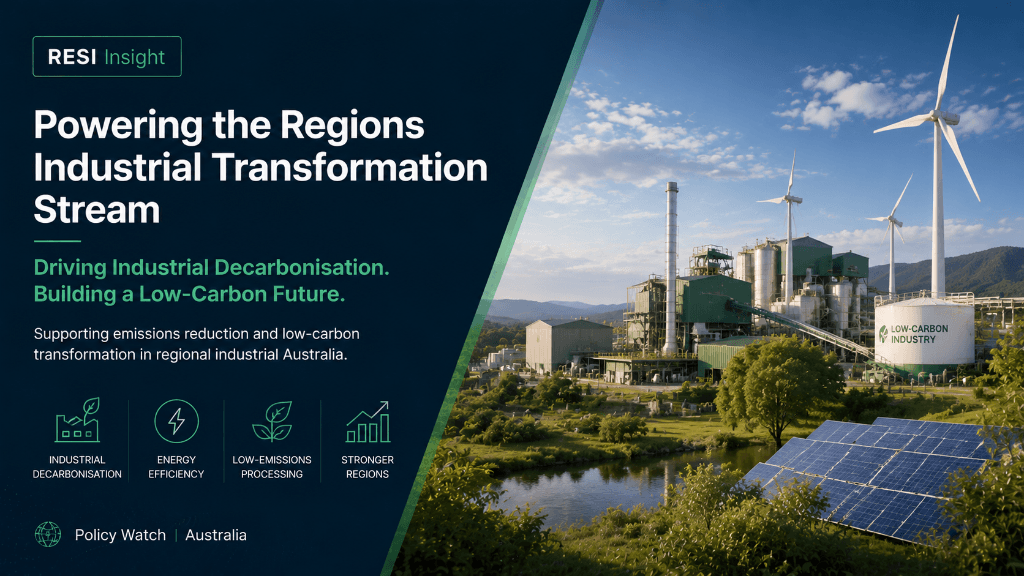
It should be noted that this is not a general-purpose grant for all businesses or ordinary construction projects. Its core focus is on emissions reduction and decarbonisation projects connected to existing industrial facilities in regional Australia. Unlike community-facing or service-oriented grants, this stream is directed at industrial decarbonisation, including electrification, energy efficiency, low-emissions processing, and fuel switching.
Focused on industrial emissions reduction and decarbonisation.
Relevant to existing industrial facilities in regional Australia.
Supports areas such as electrification, energy efficiency, low-emissions processing, and fuel switching.
For RESI’s audience, the relevance of this programme lies in the fact that, while it may not directly target residential developers, it has clear implications for materials, manufacturing, construction inputs, and the broader net-zero transition shaping the built environment. In that sense, it is not simply an industrial grant; it is also a forward-looking signal of how the wider construction ecosystem is likely to evolve.
From an industry perspective, this programme is especially relevant to organisations already thinking seriously about low-carbon manufacturing, supply-chain emissions, materials efficiency, and industrial energy use. Its importance lies in the fact that it supports not isolated efficiency measures, but more systemic industrial transformation pathways. For organisations looking to strengthen their position in low-carbon materials, net-zero construction, or more resilient supply chains, this is the kind of policy worth understanding early.
It is also significant because it reflects a broader policy shift. The emphasis is moving away from encouraging low-carbon narratives in principle and towards requiring tangible industrial transformation in practice. In other words, future competitiveness will depend not only on how well an organisation can communicate its sustainability objectives, but also on whether it can demonstrate lower-emissions production, greater efficiency, and a credible transition capability.
That said, this programme should not be understood as a general-purpose grant for all businesses. It is more suitable for organisations with a clearly defined industrial context, a practical technology or process transition pathway, and a project rationale that can be aligned with the objectives of industrial decarbonisation. The real challenge lies not in hearing about the opportunity, but in structuring the project clearly enough to demonstrate that it genuinely fits the programme.
At the time of RESI’s publication, the Australian Renewable Energy Agency (ARENA) had allocated the remaining funding under the Industrial Transformation Stream to Round 3. This round is structured as an open, ongoing process, with enquiries accepted until the available funding is exhausted. For organisations with a clearly defined industrial context and decarbonisation pathway, early suitability assessment is therefore particularly important.
What can RESI do?
RESI continues to monitor policy developments and to review the application logic, core process requirements, and common barriers associated with relevant grant opportunities. Our aim is to help the industry assess, at an earlier stage, whether a particular opportunity is suitable, whether it is worth pursuing, and what the next step into the process may look like. For many organisations, gaining clarity on direction before formally commencing an application is often more valuable than rushing into the process too early.
Contact RESI
If you are currently exploring low-carbon manufacturing, building material supply chains, industrial decarbonisation, energy efficiency improvement, or whether your business may be able to align with net-zero transition policy, then the Powering the Regions Industrial Transformation Stream is worth investigating early. As the technical requirements, eligibility thresholds, and supporting documentation are often complex, it is generally advisable to undertake an initial feasibility and suitability assessment before making a formal commitment. If you would like to assess whether your project may be suitable to proceed, you are welcome to contact RESI.
References & Data Sources
Australian Government GrantConnect. (2026). Current Grant Opportunity List and related official guidance pages.
Australian Renewable Energy Agency. (2026). Powering the Regions Industrial Transformation Stream.