
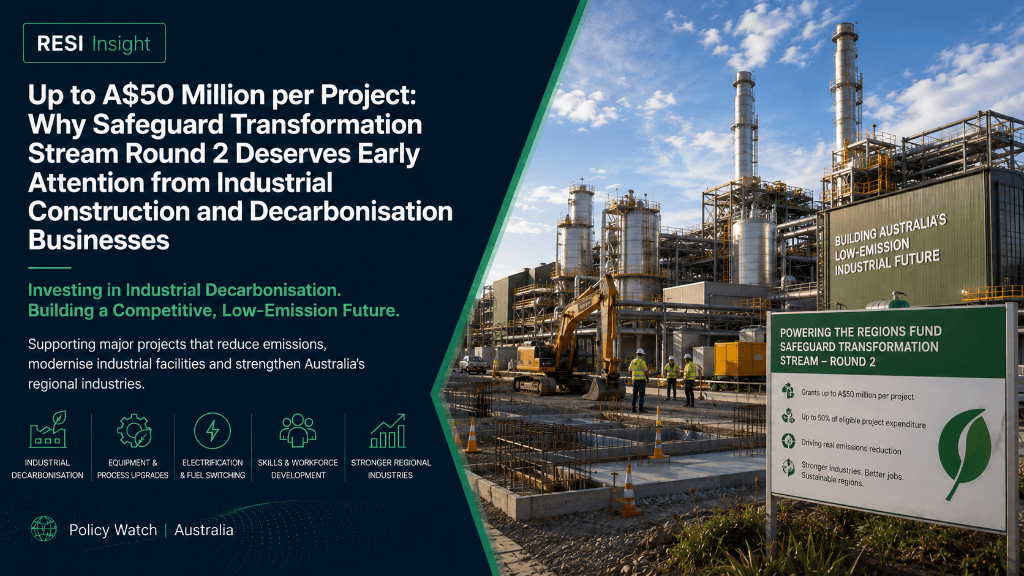
Up to A$50 Million per Project: Why Safeguard Transformation Stream Round 2 Deserves Early Attention from Industrial Construction and Decarbonisation Businesses
For businesses and organisations seeking government funding, GrantConnect and the Australian Government’s regional infrastructure funding pages are important official sources for identifying policy opportunities. The key issue is not simply knowing that a grant exists, but understanding which infrastructure priorities are attracting public investment and whether an organisation’s engineering, advisory and project-delivery capabilities are well positioned to participate.
Up to A$50 Million per Project: Why Safeguard Transformation Stream Round 2 Deserves Early Attention from Industrial Construction and Decarbonisation Businesses
Australia’s industrial decarbonisation agenda is moving from policy targets towards larger-scale capital projects.
For businesses involved in industrial facilities, production assets, electrification, equipment upgrades, energy efficiency, low-emissions manufacturing or engineering retrofits, the currently open Powering the Regions Fund – Safeguard Transformation Stream Round 2 is a significant funding opportunity worth assessing.
Approximately A$321 million is available in this round. Individual grants range from A$500,000 to A$50 million, and Commonwealth funding can cover up to 50 per cent of eligible project expenditure.
This makes the programme a significant capital-support opportunity for industrial decarbonisation in Australia.
Safeguard Transformation Stream Round 2
The Safeguard Transformation Stream forms part of the Powering the Regions Fund and is primarily directed towards trade-exposed industrial facilities covered by the Safeguard Mechanism.
The Australian Government has announced A$600 million for the stream overall, with approximately A$321 million available through Round 2 through to 31 March 2033.
The programme objectives include:
Supporting eligible industrial facilities to reduce Scope 1 emissions.
Helping Australia progress towards its 2030, 2035 and 2050 emissions-reduction targets.
Reducing the risk of carbon leakage where emissions-intensive production could move offshore in response to policy costs.
Helping industrial workforces build skills associated with new equipment and lower-emissions production processes.
Why Is This Grant Highly Relevant to the Construction Sector?
A key feature of the Safeguard Transformation Stream is that it does not only support research reports or conceptual proposals.
Published eligible-expenditure categories can include:
Newly purchased or pre-existing plant and equipment.
Hired or leased plant.
Constructed plant.
Labour expenditure.
Contract expenditure.
Training associated with new equipment and processes.
Decommissioning of old equipment.
Round 2 also allows certain Front-End Engineering and Design (FEED) costs to be claimed where they are directly linked to the proposed capital works. For applicants with annual turnover of A$3 billion or less, eligible FEED expenditure is capped at 10 per cent of the total grant funding sought, up to A$5 million. Pre-feasibility and general feasibility studies remain ineligible.
In practical terms, this means that industrial decarbonisation projects requiring real engineering and construction delivery may fall within the scope of eligible expenditure.
Potential project activity may include:
Replacement of industrial production equipment.
Electrification of production lines.
Fuel switching.
Installation of new low-emissions production equipment.
Industrial-heat system upgrades.
Energy-efficiency works.
Electrical-distribution and power-infrastructure upgrades.
Industrial-facility retrofits.
Structural and civil works required for new equipment installation.
Shared infrastructure located in Regional Australia with a practical connection to an eligible facility and the grantee.
For engineering firms, industrial contractors, equipment suppliers and project-management teams, this gives the programme direct relevance across the industrial project-delivery chain.
What Does a Maximum Grant of A$50 Million Mean?
A grant ceiling of A$50 million per project gives the programme capacity to support substantial industrial capital works.
Larger grant amounts also imply higher expectations for project maturity. Government funding is not awarded simply because a project has an environmental benefit.
Applicants will generally need to demonstrate:
Material emissions-reduction outcomes.
A technically credible and deliverable project pathway.
A project team with sufficient capability and capacity.
A sound financial structure.
An appropriate co-funding contribution.
Genuine additionality from government support.
The official assessment framework places particular weight on the project’s contribution to emissions-reduction objectives, the applicant’s delivery capability and the extent to which grant funding changes whether, when or how the project proceeds.
For businesses considering a major capital project, this means the funding application cannot be separated from the underlying engineering and commercial case. Technology selection, emissions impact, project scope, capital cost, co-funding and delivery capability all need to form part of a credible investment proposition.
Why Is the Application Window Attractive?
Round 2 is not limited to a single short application window. Applications are assessed across several batches:
Batch 1: closed.
Batch 2: closes at 5.00 pm AEST on 5 November 2026.
Batch 3: closes at 5.00 pm AEST on 6 May 2027.
Round 2 therefore remains open until 6 May 2027.
For businesses that have not yet finalised their technical design, capital budget, supplier selection or engineering scope, there is still a comparatively substantial preparation window.
Applicants should also note that project activities intended to be claimed under the grant must not commence before a grant agreement is executed. Preliminary and planning costs incurred before this point are generally ineligible.
Rather than seeing a grant and immediately starting an application, a more useful first question is whether the business has a sufficiently mature investment opportunity to become a major industrial decarbonisation project.
Which Businesses Should Pay Particular Attention?
Across the industrial value chain, the programme may be particularly relevant to:
Owners or operators of trade-exposed Safeguard Mechanism facilities, excluding new or expanded coal or gas production facilities.
Industrial manufacturers.
Metals, minerals and materials producers.
Industrial engineering and EPC businesses.
Electrification-solution providers.
Industrial equipment and production-line suppliers.
Energy-efficiency and industrial-heat technology businesses.
Industrial automation and control-system providers.
Civil and industrial-building contractors.
Engineering-design and project-management consultancies.
Direct applicants must satisfy the programme’s Safeguard-facility eligibility requirements.
General construction and engineering businesses do not automatically become eligible applicants simply because they have delivery capability, but they may participate as technology suppliers, engineering advisers, contractors or other delivery providers.
Where organisations participate as formal project partners in a joint application, those partner organisations must also satisfy the relevant eligibility requirements.
This distinction is important because the programme may create opportunities across the industrial supply chain even where a business is not itself positioned to lead the grant application.
Where Is the Opportunity for the Construction Sector?
A major industrial decarbonisation project is rarely a simple equipment purchase.
Once a project moves into engineering delivery, it may involve project design, equipment foundations, building modifications, electrical systems, transformers, structural works, piping, control systems, construction, commissioning and operational transition.
For the construction sector, the significance of the Safeguard Transformation Stream therefore goes beyond the headline figure of up to A$50 million in government support.
The larger opportunity is that public funding is helping existing emissions-intensive industrial assets form new capital-upgrade projects — and those projects ultimately need to be designed, procured and built.
For engineering, construction and project-delivery businesses, the opportunity may therefore sit downstream of the grant itself: helping eligible industrial facilities convert emissions-reduction plans into deliverable capital projects.
What Can RESI Do?
RESI continues to monitor the policy connection between industrial decarbonisation, manufacturing upgrades, energy transition and the construction sector, while reviewing the participation logic and project thresholds associated with relevant funding programmes.
Our aim is to help the industry assess at an earlier stage:
Whether a project may fall within the programme’s scope.
Whether the proposed applicant meets the core eligibility requirements.
Whether the project has reached an appropriate level of maturity.
Whether the engineering and capital-expenditure structure is sufficiently defined.
Whether relevant FEED activities may fall within the eligible funding scope.
Whether a business should participate as an applicant, technology supplier, engineering adviser, contractor or other delivery provider.
Whether the opportunity justifies investment in preparation for the next assessment batch.
For major industrial projects, the real challenge is rarely completing the application form. It is combining the technology, emissions, engineering, funding and commercial logic into a project that can actually be delivered.
Contact RESI
If your business is planning industrial electrification, production-equipment upgrades, energy-efficiency retrofits, low-emissions manufacturing or industrial-infrastructure projects, Safeguard Transformation Stream Round 2 is worth assessing early.
Batch 2 closes at 5.00 pm AEST on 5 November 2026, while the overall Round 2 remains open until 5.00 pm AEST on 6 May 2027, providing a comparatively generous preparation window for complex projects.
For businesses that are not direct applicants, the programme may still create opportunities through engineering design, equipment supply, civil works, electrical infrastructure, project management, construction and commissioning.
To discuss whether your project or service capability may be worth progressing into the preparation stage, please contact RESI.
References & Data Sources
Australian Government. (2026a). Powering the Regions Fund – Safeguard Transformation Stream Round 2. business.gov.au. Accessed 21 August 2026.
Australian Government. (2026b). Powering the Regions Fund – Safeguard Transformation Stream Round 2 (GO8016). GrantConnect. Accessed 21 August 2026.
Department of Climate Change, Energy, the Environment and Water. (2025). Powering the Regions Fund – Safeguard Transformation Stream Round 2: Grant Opportunity Guidelines. October 2025.