
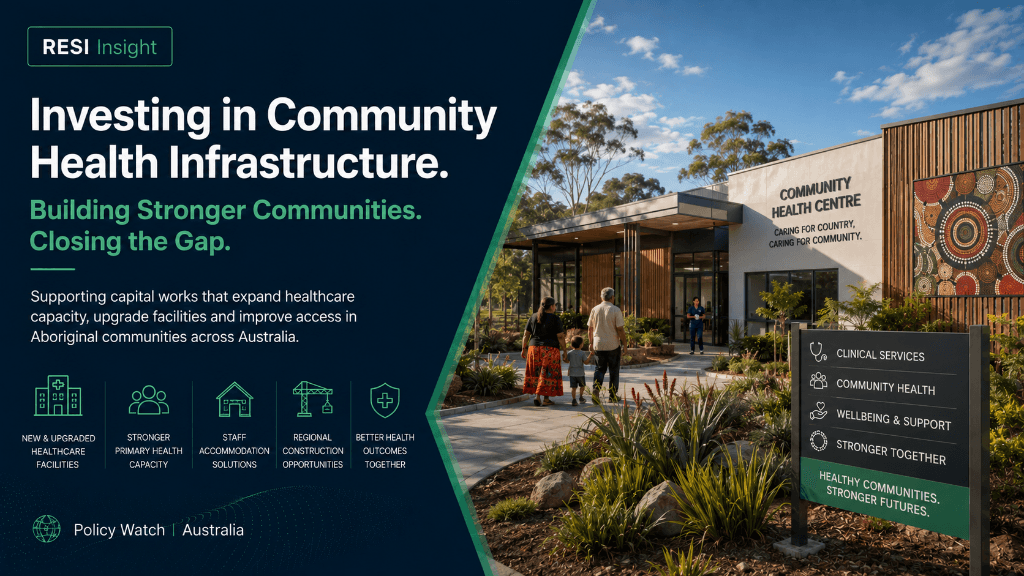
RESI Continues to Monitor Community Health Infrastructure Investment: What Construction Opportunities Could Emerge from the A$180 Million Closing the Gap Major Capital Works Program?
For businesses and organisations seeking government funding, GrantConnect and the Australian Government’s regional infrastructure funding pages are important official sources for identifying policy opportunities. The key issue is not simply knowing that a grant exists, but understanding which infrastructure priorities are attracting public investment and whether an organisation’s engineering, advisory and project-delivery capabilities are well positioned to participate.
RESI Continues to Monitor Community Health Infrastructure Investment: What Construction Opportunities Could Emerge from the A$180 Million Closing the Gap Major Capital Works Program?
The Australian Government is continuing to invest in the infrastructure capacity of Aboriginal Community Controlled Health Services (ACCHSs) through a new round of capital works funding.
If your business works across healthcare facilities, regional construction, staff accommodation, engineering design, project management, cost planning, building services or community infrastructure, Round 3 – Closing the Gap – Major Capital Works Program – 2026–27 is worth monitoring.
Unlike many government grants focused primarily on operations, training or service delivery, the purpose of this round is clear: investment in physical health infrastructure.
According to GrantConnect, up to A$180 million is available over the 2026–27 and 2027–28 financial years. Applications close at 2.00 pm ACT local time on 7 September 2026. The opportunity is being delivered through a targeted or restricted competitive process.
Closing the Gap – Major Capital Works Program – Round 3
The programme is intended to strengthen the Aboriginal Community Controlled Health Service sector through improved infrastructure and expand access to culturally appropriate, fit-for-purpose primary healthcare facilities.
Round 3 can support infrastructure such as:
Construction of new health clinics and facilities.
Upgrades, extensions, refurbishment, repairs and fit-outs to existing health infrastructure.
Improvements to infrastructure supporting primary healthcare delivery.
Essential infrastructure and service connections required to support capital works.
Housing for health professionals in eligible rural and remote locations.
Other capital works that strengthen the capacity of ACCHSs to provide culturally safe and appropriate primary healthcare.
The Australian Government has described the round as supporting new buildings as well as upgrades, repairs and maintenance to existing health infrastructure. In eligible rural and remote locations, funding may also support staff housing that assists services to recruit and retain health professionals.
It is also important to understand what sits outside the programme. The Grant Opportunity Guidelines exclude a number of activities and costs, including scoping studies, ongoing operating costs, mobile medical units and certain medical equipment used in clinical service delivery. This means that not every activity associated with developing a healthcare project will necessarily be funded through the grant itself.
This is not the first major capital investment under the programme. Two previous rounds of the Closing the Gap Major Capital Works Program provided a combined A$210 million, while Round 3 makes up to a further A$180 million available.
Why Should the Construction Sector Pay Attention?
It is important to distinguish between businesses that can apply directly for the grant and businesses that may participate in delivering the resulting projects.
General construction businesses, engineering consultancies and project-management firms are not direct applicants under this grant opportunity.
To be directly eligible, an organisation must be an Aboriginal Community Controlled Health Service currently delivering primary healthcare and be listed in Appendix A of the Grant Opportunity Guidelines. Eligible applicants must also fall within one of the permitted entity types specified by GrantConnect. Certain arrangements involving subsidiaries or auspiced organisations are also permitted under the guidelines.
For the construction sector, however, this does not mean that the programme lacks commercial relevance. Once capital projects are approved and progress towards delivery, they may generate demand for:
Architectural design and planning.
Civil and structural engineering.
Healthcare-facility design.
Electrical, mechanical and other building-services engineering.
Construction of new clinics and healthcare facilities.
Extensions, refurbishment, repairs and fit-outs to existing buildings.
Eligible accommodation for healthcare professionals.
Cost estimating and quantity surveying.
Tender and procurement support.
Project management.
Statutory approvals and essential-service connections.
Construction, commissioning, compliance and final project delivery.
The Guidelines specifically contemplate external project management, governance and procurement activities associated with the grant, as well as statutory charges and costs associated with connecting essential services such as power, water and sewerage.
However, construction and advisory businesses should not assume that every professional service associated with a project will be paid from grant funding. For example, scoping studies are specifically listed as ineligible expenditure. The commercial opportunity therefore needs to be considered within the structure and approved scope of each individual project.
For the construction industry, the key question is therefore not simply who can apply for the grant, but which funded projects may subsequently move into design, procurement and construction.
What Policy Signal Does A$180 Million Send?
For RESI, the significance of this round is not limited to the size of the funding pool. More importantly, it reflects a clear public-infrastructure priority: strengthening primary healthcare capacity through investment in physical infrastructure.
The Australian Government and the National Aboriginal Community Controlled Health Organisation (NACCHO) co-designed Round 3 so that funded projects reflect ACCHO and community priorities. The programme supports Priority Reform Two under the National Agreement on Closing the Gap by strengthening the community-controlled sector.
In urban, regional, rural and remote communities, effective healthcare delivery depends on more than the availability of clinicians. It also depends on whether:
Suitable and fit-for-purpose healthcare buildings are available.
Clinical spaces can accommodate current and future service demand.
Facilities are safe, compliant, accessible and culturally appropriate.
Infrastructure can support increased service capacity.
Eligible rural and remote services can provide accommodation that helps attract and retain health professionals.
The Department has reported that completed projects from previous rounds have, on average, recorded a 15 per cent increase in health services provided to patients and a 40 per cent increase in staffing compared with previous years. These figures are programme-level reported outcomes rather than guaranteed outcomes for individual projects, but they help explain why physical infrastructure continues to form part of the broader Closing the Gap health strategy.
In this sense, the funding connects two areas that are often considered separately: public health policy and construction-infrastructure delivery.
Which Businesses Should Pay Particular Attention?
From a construction-industry perspective, the following businesses may have particular reason to monitor downstream opportunities:
Contractors with healthcare or community-building experience.
Regional and remote-area construction businesses.
Architects and healthcare-facility design consultants.
Civil, structural, electrical and mechanical engineering consultancies.
Building-services and essential-infrastructure specialists.
Modular and prefabricated-building businesses.
Staff-accommodation and regional residential builders.
Quantity surveyors and cost consultants.
Project-management and project-delivery advisers.
Businesses already providing services to Aboriginal organisations, local governments or regional communities.
The participation model needs to be understood clearly. These businesses are generally more likely to participate as advisers, designers, contractors, suppliers or delivery partners than as direct grant applicants.
For businesses already operating in regional or community infrastructure, the programme may therefore be particularly relevant as a potential future project pipeline rather than as a direct grant opportunity.
Why Is It Worth Monitoring Now?
Applications close at 2.00 pm ACT local time on 7 September 2026. For eligible direct applicants, the preparation window is therefore becoming increasingly limited.
For construction and engineering businesses, however, the commercial opportunity may become more visible after the grant application period closes.
Successful capital projects will still need to move from funding approval into practical delivery. Depending on the project, this may involve scope confirmation, detailed design, cost verification, approvals, procurement, tendering, contracting, construction and final commissioning.
This means the industry should not interpret the grant closing date as the end of the opportunity.
Instead, it may mark the beginning of a later project-delivery phase in which individual ACCHSs begin engaging the consultants, contractors, suppliers and specialist advisers required to deliver funded works.
For businesses seeking to participate, understanding which organisations have projects progressing, what types of infrastructure are being proposed and how procurement may be structured could therefore become increasingly important over the following months.
What Can RESI Do?
RESI continues to monitor public construction, community infrastructure, regional development and government capital programmes, with a particular focus on how policy funding can translate into practical opportunities for the construction sector.
Our aim is to help the industry assess at an earlier stage:
Whether an organisation is directly eligible to apply.
Whether a proposed project aligns with the programme’s infrastructure objectives.
Whether a funded project may generate downstream design, engineering or construction demand.
Whether a business should participate as an applicant, adviser, designer, contractor, supplier or delivery partner.
Which capabilities may align with future procurement requirements.
Whether professional services or project activities fall within or outside the likely grant-funded scope.
Whether it is worth preparing for future tender and project-delivery opportunities.
For many construction businesses, understanding where government funding may create real projects can be more valuable than focusing only on grants for which they can apply directly.
Contact RESI
If your business works across healthcare construction, regional infrastructure, community facilities, staff accommodation, engineering design, building services, project management or construction delivery, the Closing the Gap Major Capital Works Program – Round 3 is worth continuing to monitor.
Even where a business is not a direct applicant, funded projects may create downstream demand for design, engineering, procurement, construction and project-delivery services.
For businesses already working with Aboriginal organisations, healthcare providers or regional communities, early awareness of the programme may also help identify where relevant capabilities could support future capital works.
To discuss where your service capability may fit within the project lifecycle, please contact RESI.
References & Data Sources
Australian Government. (2026). Round 3 – Closing the Gap – Major Capital Works Program – 2026–27 (GO8511). GrantConnect. Accessed 14 August 2026.
Australian Government Department of Health, Disability and Ageing. (2026a). Round 3 – Closing the Gap – Major Capital Works Program – 2026–27: Grant Opportunity Guidelines.
Australian Government Department of Health, Disability and Ageing. (2026b). $180 million for First Nations health infrastructure. Published 5 August 2026.